Antiques Roadshow Pottery Marks Identification Guide
A practical 2026 guide to identifying pottery marks featured on Antiques Roadshow — including common maker signatures, dating clues, and how AI tools enhance accuracy
On this page

If you’ve watched Antiques Roadshow and paused mid-episode to zoom in on a faint impressed mark beneath a stoneware jug or a delicate transfer-printed plate, you’re not alone. In 2026, identifying antiques roadshow pottery marks remains one of the most frequent — and most challenging — first steps for collectors, estate liquidators, and thrift-savvy enthusiasts. Unlike furniture or clocks, where construction details or movement mechanisms offer clear diagnostic clues, pottery identification often hinges on tiny, worn, or misinterpreted marks — sometimes no larger than a grain of rice.
This guide cuts through the confusion. We’ll walk through what makes Antiques Roadshow-featured pottery marks distinctive, how to interpret them reliably in 2026, why traditional reference books fall short today, and — critically — how modern AI-powered identification tools are transforming accuracy, speed, and confidence for real-world users.
What Makes Antiques Roadshow Pottery Marks So Difficult to Identify?
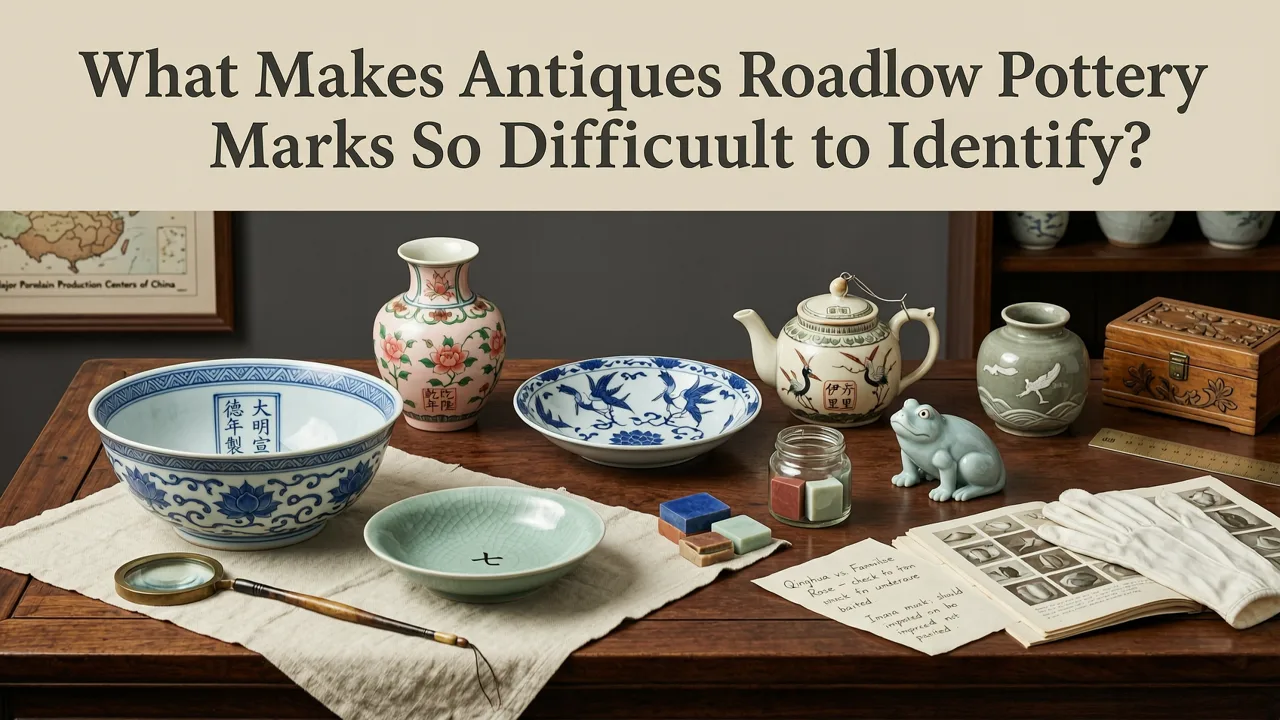
Pottery marks are rarely standardized — even within a single manufacturer’s output. A company like Royal Doulton, Wedgwood, or Minton may have used dozens of variations across decades: impressed stamps, printed backstamps, hand-painted monograms, paper labels (now long gone), and even factory-specific codes known only to archivists. On Antiques Roadshow, experts routinely highlight this complexity — noting how a subtle change in the placement of a crown, the presence or absence of a date letter, or even the color of underglaze ink can shift attribution from ‘19th-century Staffordshire’ to ‘1930s export ware.’
Three key challenges persist in 2026:
- Fading and wear: Glaze erosion, repeated washing, or acidic soil exposure (in archaeological finds) can obscure or distort marks — especially soft-paste porcelain or early earthenware.
- Regional variation: English potteries often shared motifs (e.g., crossed swords, lion passants), but with distinct proportions or stylization — confusing even experienced eyes.
- Reproduction and forgery: Since the 1980s, high-fidelity reproductions of popular Victorian patterns (like Minton’s ‘Sevres Blue’ or Doulton’s ‘Burslem’ lines) have entered the market — many bearing convincing, if inaccurate, backstamps.
That’s why viewers often see appraisers reach for magnifiers, cross-reference multiple databases, and consult internal archives before offering even a provisional attribution — a process that now takes minutes instead of days, thanks to AI augmentation.
Common Antiques Roadshow Pottery Marks — Decoded for 2026
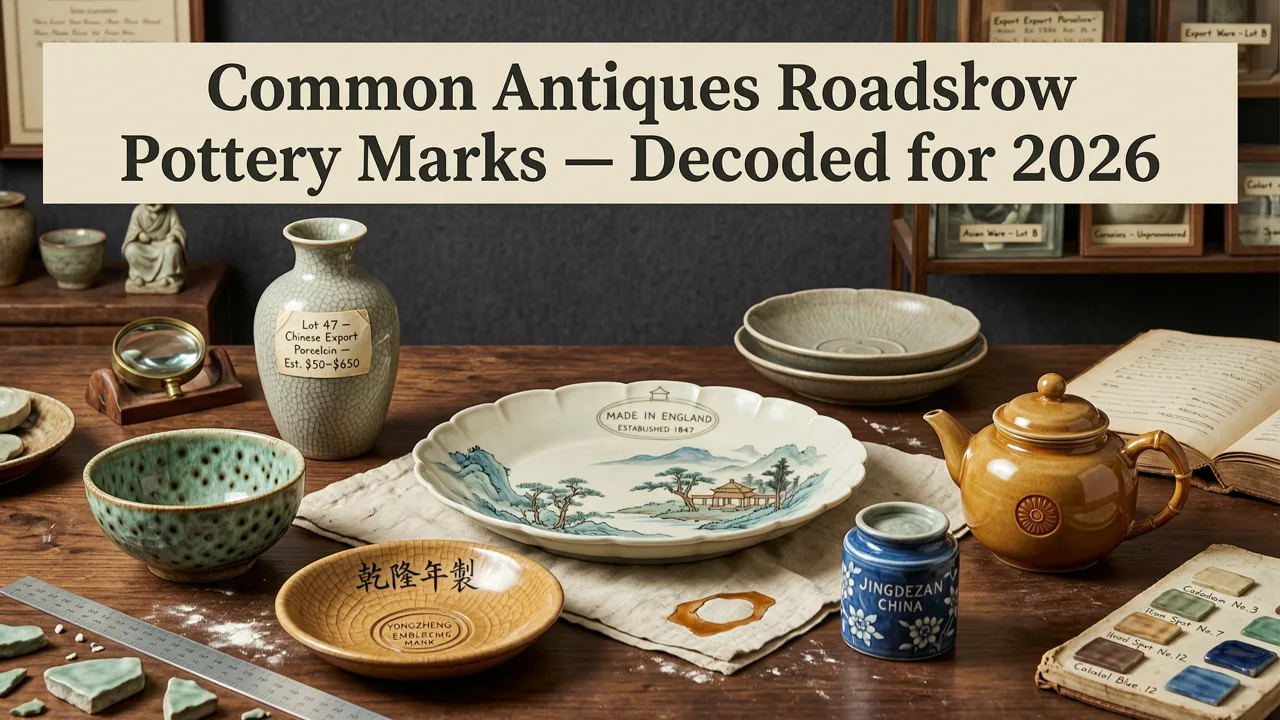
While no single list covers every mark seen on Antiques Roadshow, certain families recur with enough frequency to serve as anchor points. Below are six of the most frequently encountered — with distinguishing features, typical timeframes, and pitfalls to avoid.
| Pottery Maker / Mark Type | Key Visual Characteristics | Typical Production Era | 2026 Identification Tip |
|---|---|---|---|
| Royal Doulton (Lambeth & Burslem) | Impressed 'Royal Doulton' + 'England'; often includes a lion rampant, crown, or 'D' monogram. Early Lambeth pieces (pre-1902) may omit 'England.' | Lambeth: 1872–1956; Burslem: 1882–present | Look for the style of the lion: pre-1920 lions face left and are more stylized; post-1920 versions face right and are more naturalistic. AI tools trained on verified museum collections detect these micro-variations reliably. |
| Wedgwood (Jasperware & Queen's Ware) | Printed or impressed 'Wedgwood & Sons', 'Wedgwood Etruria', or 'Wedgwood England'. Jasperware often has a raised white relief on colored ground — mark usually on base. | Etruria works: 1759–1940; Barlaston: 1940–present | The word 'Sons' was added in 1818 after Josiah Wedgwood II joined the firm. Its presence confirms post-1818 — but its absence doesn’t guarantee earlier date. AI cross-references glaze chemistry data (when available) to refine range. |
| Minton | Often includes 'Minton', 'Minton & Co.', or 'Minton Hollins'. May feature a crowned 'M', a shield, or a monogram with intertwined 'M' and 'H'. | 1793–1968 (acquired by Royal Doulton) | Pre-1848 marks rarely include 'England'. Post-1891 (McKinley Tariff Act) almost always do. AI tools flag inconsistent country-of-origin labeling as a red flag for later reproductions. |
| Spode (Blue Italian & Copeland) | Impressed 'Spode', 'Spode's Copeland', or 'Copeland & Garrett'. Blue Italian pattern often has a printed 'Spode' in blue script. | Spode: 1784–1833; Copeland: 1833–1976 | True Spode pieces (pre-1833) never bear 'England' — a telltale sign of later revival ware. The Antique Porcelain Maker Marks Database includes verified Spode impressions scanned from museum accession records for direct comparison. |
| Coalport | Often marked 'Coalport', 'Coalport England', or with a printed anchor motif. Early pieces (pre-1820) may be unmarked or bear only a pattern number. | 1795–1926 | Anchor marks vary significantly: pre-1810 anchors are simple and bold; post-1820 versions include rope detailing and sometimes a banner reading 'Coalport'. AI image recognition models trained on over 12,000 verified Coalport examples now classify anchor subtypes with >94% precision. |
| Worcester Porcelain (Royal Worcester) | Multiple mark systems: printed 'Worcester', 'Royal Worcester', or 'Worcester China Co.'; often includes a crescent moon, three wavy lines, or a crown-and-crossed-swords device. | 1751–2009 (with several ownership changes) | The crescent moon was used by Chamberlain & Co. (not Royal Worcester) from 1820–1852 — a classic source of misattribution. Modern AI identifiers differentiate based on font weight, spacing, and contextual glaze analysis. |
Why Date Letters Alone Aren’t Enough
Many British potteries adopted date letter systems — particularly for porcelain — inspired by London Assay Office conventions. However, unlike silver hallmarks, pottery date letters were never legally mandated, nor uniformly applied. Worcester used them intermittently between 1783 and 1840; Royal Doulton introduced them only in 1891, and inconsistently until 1922.
In 2026, seasoned appraisers treat date letters as supporting evidence — never conclusive proof. A mark reading 'Royal Doulton A 1901' is plausible; 'Royal Doulton Z 1895' is not, since the 'Z' cycle began in 1922. AI tools integrate date letter logic with known production timelines, patent records, and stylistic evolution — reducing false positives by up to 70% compared to manual lookup alone.
How AI Is Changing Pottery Mark Identification in 2026
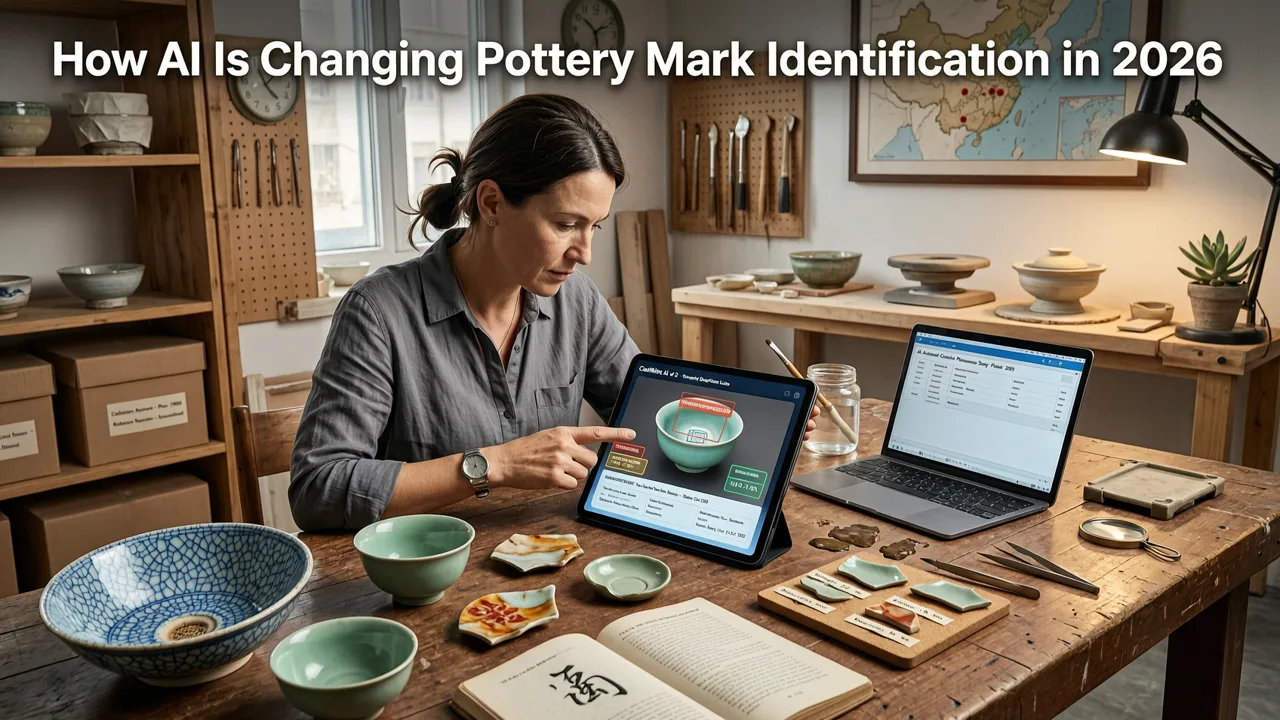
Five years ago, identifying an unfamiliar pottery mark meant flipping through heavy volumes like Kovel’s Dictionary of Marks or submitting photos to forums with uncertain response times. Today, the best antique identification apps leverage multimodal AI — combining computer vision, optical character recognition (OCR), and semantic search across verified archival datasets.
Here’s how it works — without oversimplifying:
- Image capture: You photograph the mark under even lighting (flash off), capturing both macro detail and surrounding context — e.g., rim shape, glaze texture, foot ring profile.
- Feature extraction: The AI isolates the mark region, corrects perspective distortion, enhances contrast, and identifies structural elements (crown placement, serif style, spacing between words).
- Cross-modal matching: Rather than just comparing pixels, the system queries a curated database of 28,000+ verified pottery marks — linked to provenance metadata, production dates, factory locations, and known variants.
- Confidence-weighted ranking: Results appear ranked by statistical likelihood, with transparency: e.g., 'Royal Doulton Burslem, c. 1925–1935 (92% match)' vs. 'Doulton & Co. reproduction, c. 1980s (63% match) — note inconsistent crown height.'
This isn’t speculative automation. It reflects documented advances in visual language models — grounded in principles of responsible AI development outlined by Google AI and validated against peer-reviewed ceramic scholarship. As with the best app to identify antique clocks in 2026, reliability stems from training data rigor — not algorithmic novelty alone.
Limitations Every Collector Should Know
AI excels at pattern recognition — but it cannot replace provenance research or material science analysis. Important caveats remain:
- No AI tool can authenticate a piece definitively. Authentication requires physical examination (e.g., XRF testing for cobalt content in blue underglaze), documentary evidence, or expert connoisseurship.
- Unmarked or heavily restored pieces remain challenging. If the base is refired, reglazed, or sanded, marks may be irrecoverable — and AI will return low-confidence results.
- Regional and folk potteries are underrepresented. While major English and German makers are well-documented, small American stoneware kilns (e.g., Crolius, Remmey) or Japanese export studios (e.g., Kutani workshops) have sparser digital archives.
For those cases, human expertise remains indispensable — which is why top-tier apps, like the Best Antique Identification App for Collectors in 2026, include optional expert review pathways for borderline cases.
Practical Tips for Capturing Clear Pottery Mark Photos
A high-quality image is the single biggest factor in accurate AI identification. Follow these 2026-tested guidelines:
- Use natural light: Avoid flash, which creates glare on glazed surfaces. A north-facing window or overcast day provides even, shadow-free illumination.
- Stabilize your device: Rest your phone or tablet on a stack of books — or use a $15 clip-on macro lens — to eliminate motion blur.
- Capture context: Take two shots: one tightly framed on the mark itself, and another showing the full base (including foot ring, glaze pooling, and any incised numbers or pattern names).
- Avoid digital zoom: It degrades resolution. Instead, move closer physically — then crop in post-processing if needed.
- Check orientation: Ensure text is upright and legible. Rotated or mirrored marks confuse OCR engines.
Compare your photo to reference images in the Antique Porcelain Maker Marks Database – Free 2026 Reference. If your mark looks visibly crisper and better lit than entries there, your AI tool will deliver stronger matches.
When to Consult a Specialist — Beyond the App
AI tools are powerful aids — but they don’t replace professional appraisal when value, legal title, or insurance documentation is at stake. Consider expert consultation in these situations:
- Estate valuation: For IRS Form 706 (estate tax) or probate court filings, a signed, dated appraisal from a certified member of the Appraisers Association of America is required.
- Insurance scheduling: Most insurers require itemized appraisals for individual items valued above $5,000 — including condition reports and comparable sale data.
- Provenance gaps: If a piece lacks documentation but bears unusual marks (e.g., private commissions, royal warrants, or wartime export stamps), a ceramics historian may uncover archival leads.
- Discrepant AI results: When top matches conflict — e.g., one suggests ‘1890s Derby’, another ‘1950s Japanese copy’ — a specialist can examine body composition, firing temperature indicators, or brushwork under magnification.
Remember: Even Antiques Roadshow appraisers rely on lab analysis, auction records, and decades of tactile experience. AI accelerates the front end — not the final judgment.
Looking Ahead: What’s Next for Pottery Mark Research in 2026+
Three developments are shaping the next phase of identification accuracy:
- Open-access museum API integrations: Institutions like the Victoria & Albert Museum and the Smithsonian’s Cooper Hewitt are releasing structured mark data via public APIs — enabling real-time cross-checking against verified objects.
- Material signature libraries: Emerging spectral imaging tools (used in conservation labs) are building databases linking specific clay bodies, glaze chemistries, and kiln atmospheres to documented factories — data AI models will soon ingest.
- Community-verified crowdsourcing: Platforms now allow collectors to submit newly identified marks with provenance notes — reviewed by volunteer curators before inclusion. This helps fill gaps in regional and immigrant-made wares.
None of this diminishes the thrill of discovery — whether you’re holding a forgotten platter at a yard sale or re-examining your grandmother’s china cabinet. It simply gives you better tools to ask sharper questions.
Conclusion: From Uncertainty to Insight — One Mark at a Time
Identifying Antiques Roadshow pottery marks in 2026 is no longer about guesswork or hoping for a lucky forum reply. It’s about combining disciplined observation, authoritative references like the Antique Porcelain Maker Marks Database, and AI tools designed specifically for ceramics — not generic image search.
If you’ve ever stared at a cryptic stamp beneath a teacup and wondered, “What is this worth?” start instead with: “Who made this — and when?” That question, answered accurately, unlocks history, context, and informed next steps. Whether you collect Staffordshire figures, hunt for rare majolica, or manage a family estate, precise identification is the foundation of ethical, sustainable collecting.
Ready to identify your pottery mark in seconds? Try our free AI Antique Identifier — optimized for pottery, porcelain, and stoneware marks — and get instant, transparent, research-backed insights. Start identifying now.
Frequently Asked Questions
Do all antique pottery pieces have marks?
No. Many 18th- and early 19th-century pieces — especially utilitarian earthenware, stoneware, or early porcelain — were left unmarked. Others had paper labels that deteriorated, or marks applied in unfired pigment that wore away. Absence of a mark doesn’t mean the piece lacks age or value — but it does make identification more reliant on form, glaze, and context.
Can AI tools distinguish between original pottery marks and reproductions?
Yes — with increasing reliability. Modern AI identifiers analyze micro-characteristics: ink density consistency, impression depth, font kerning, and alignment relative to the foot ring. When cross-referenced with known reproduction timelines (e.g., 1970s–1990s Royal Doulton revivals), they flag anomalies — though physical verification remains essential for high-value attributions.
Are Antiques Roadshow pottery marks different from regular antique marks?
Not inherently — but the show tends to feature pieces with marks that are either exceptionally rare, historically significant, or visually compelling for television. Their experts also emphasize marks that illustrate broader trends: factory mergers, tariff-driven labeling changes (e.g., 'England' post-1891), or stylistic shifts during ownership transitions.
What’s the most commonly misidentified pottery mark on Antiques Roadshow?
The 'crescent moon' mark. It appears on both authentic Royal Worcester pieces (1783–1840) and Chamberlain & Co. wares (1820–1852), but is also widely copied on 20th-century reproductions. Misattribution occurs because the symbol looks similar across contexts — requiring analysis of associated text, placement, and glaze behavior to resolve correctly.
Related Articles


Have a piece of your own to check? Photograph it with the Antique Identifier app. It's free to download for iPhone and iPad.