How to Identify Antique Pottery Marks: A 2026 Visual Guide
Learn how to identify antique pottery marks with this 2026 guide. Discover common symbols, maker backstamps, dating tips, and tools to authenticate ceramics fast.

How to Identify Antique Pottery Marks: The Quick Answer
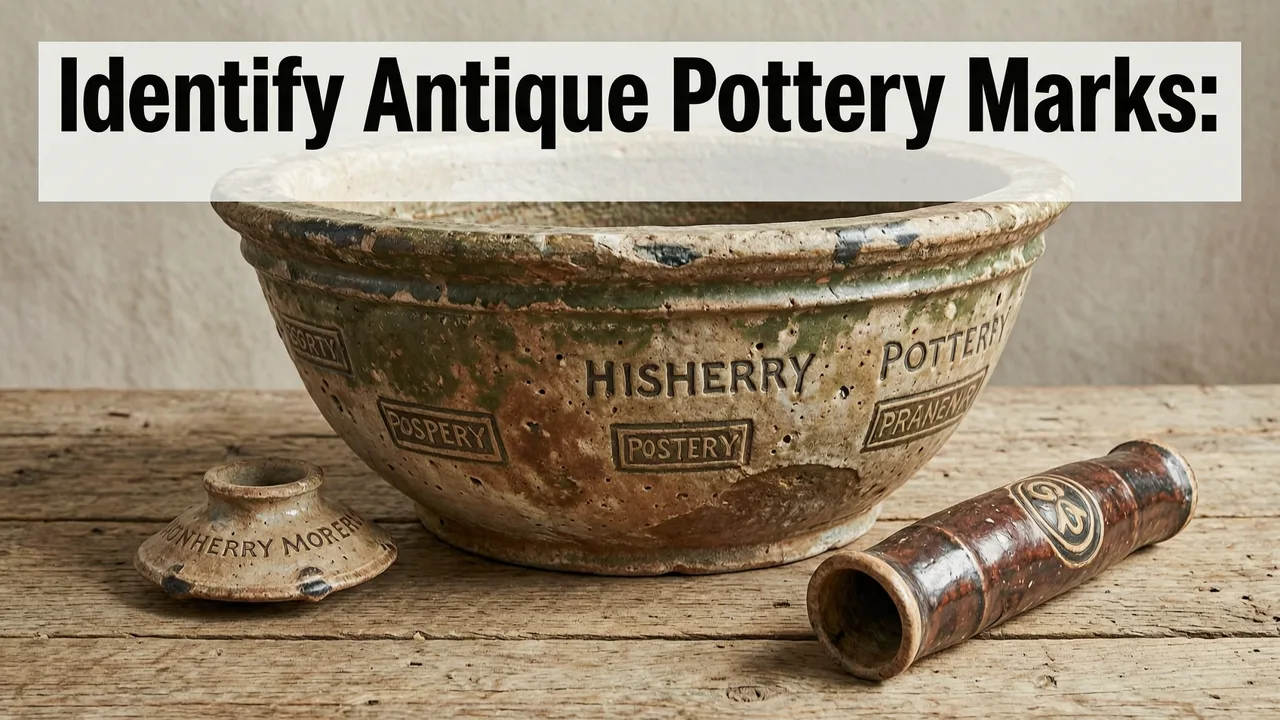
If you've ever flipped a ceramic vase, mug, or plate and stared at a cryptic symbol stamped under the base, you already know the frustration. How to identify antique pottery marks is one of the most searched questions among collectors, thrifters, and estate-sale hunters — and in 2026, the answer is easier than ever thanks to AI-powered lookup tools and digitized maker databases. The short version: locate the backstamp or impressed mark on the unglazed foot, photograph it clearly, compare it to verified reference databases, and cross-check the style, glaze, and clay body to confirm the era and maker.
This guide walks you through exactly how to read pottery marks, spot common fakes, and use modern identification tools to move from "old pot" to "documented antique" with confidence.
Why Pottery Marks Matter for Identification and Value
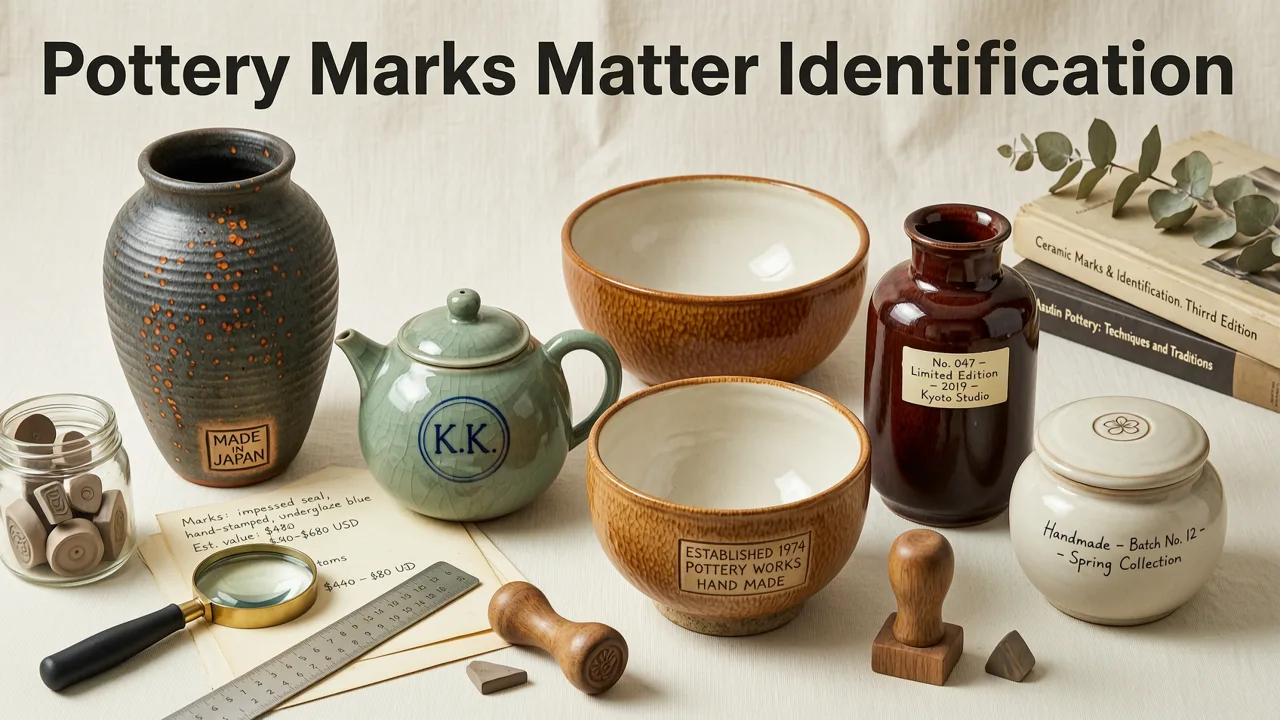
A pottery mark is essentially a maker's signature. It can tell you who produced the piece, where it was made, roughly when, and sometimes even the pattern name. For collectors and resellers, that small stamp under the foot is the difference between a $5 garage-sale find and a $500 authenticated antique.
Marks also serve as a first line of defense against reproductions. Many 20th-century copies carry deliberately misleading stamps, and knowing what genuine marks look like — their font, placement, color, and wear patterns — is critical. If you're evaluating a piece for insurance or resale, a documented mark often unlocks a far more accurate antique appraisal cost guide and helps you decide whether a professional valuation is worth the fee.
What Counts as a "Pottery Mark"?
- Backstamp: A printed or painted mark applied after firing, usually in ink or enamel.
- Impressed mark: Stamped into wet clay before firing; often found on stoneware and redware.
- Incised mark: Cut or carved into the leather-hard clay by hand.
- Applied label: Paper or foil stickers, common on Art Nouveau and mid-century pieces (often lost over time).
- Molded mark: Raised lettering formed as part of the mold itself.
Step-by-Step: How to Identify Antique Pottery Marks
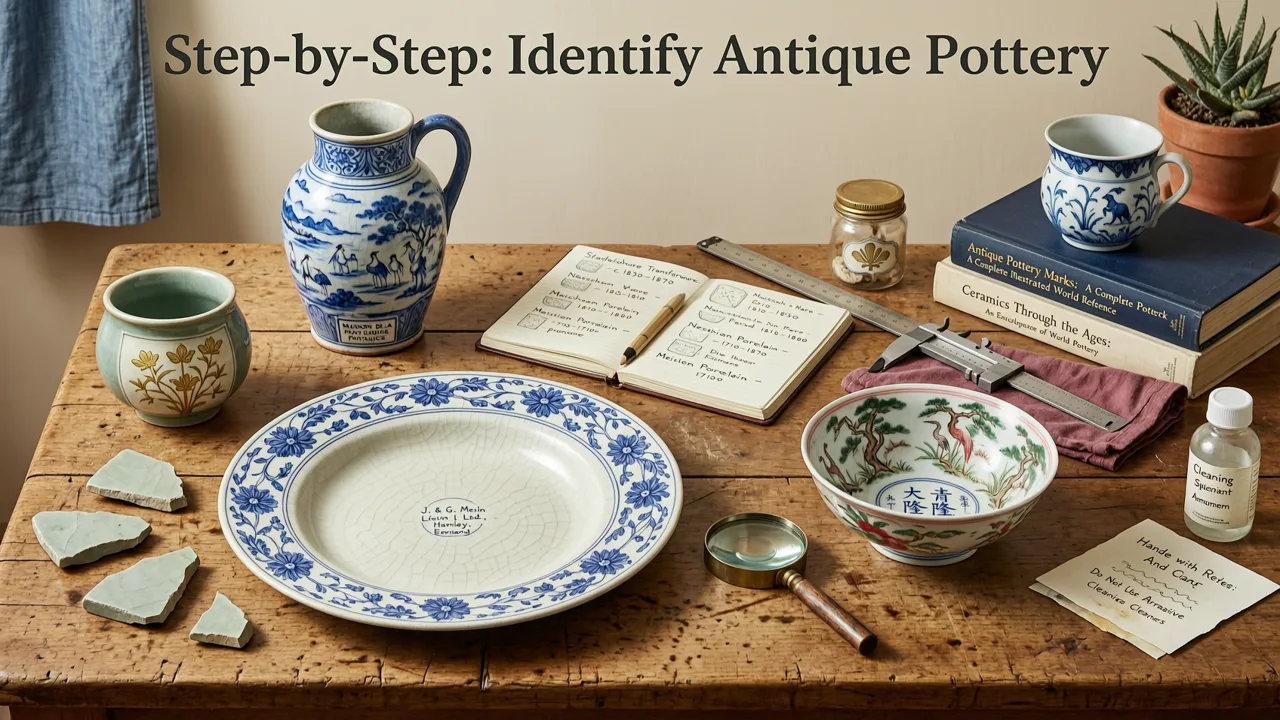
Identifying a pottery mark is a process of elimination. Follow these steps in order and you'll narrow down possibilities quickly.
Step 1 — Examine the Base Under Good Light
Turn the piece over and look at the unglazed foot ring. Use a bright LED light at a low angle to reveal shallow impressed or incised marks that overhead lighting misses. A jeweler's loupe (10x magnification) helps with faded backstamps.
Step 2 — Photograph the Mark Clearly
Place the piece on a neutral background, use natural daylight or a ring light, and shoot straight down. Avoid flash glare on glossy glazes. A clean photo is essential if you plan to upload it to an AI identification app such as the ones reviewed in our best apps for antique identification roundup.
Step 3 — Note the Mark's Visual Characteristics
Before searching any database, record these details:
- Shape of the mark (circle, shield, rectangle, wreath, crown)
- Color (blue, black, red, green, gold)
- Lettering style (serif, sans-serif, script, block capitals)
- Presence of country-of-origin wording ("England," "Made in Occupied Japan," "Germany")
- Pattern name or number, if legible
Step 4 — Cross-Reference a Verified Database
Search the mark in a digitized reference. The antique porcelain maker marks database on this site is a solid free starting point for European and American ceramics. For broader results, compare your photo against multiple sources to rule out look-alikes.
Step 5 — Confirm With Secondary Clues
A mark alone is never enough. Verify the identification by checking the clay body color, glaze type, weight, and decorative style against the suspected maker and era. We cover the full checklist in our guide on how to tell if an antique is valuable.
Common Antique Pottery Marks and What They Mean
Below is a quick-reference table of widely encountered marks. This is not exhaustive, but it covers the symbols collectors see most often at auctions and estate sales.
| Mark Description | Maker / Region | Typical Date Range | Notes |
|---|---|---|---|
| Blue crowned "N" in wreath | Royal Doulton (England) | 1902–1922 | Pre-1922 Doulton & Watts; crown style changed after 1927. |
| Interlocking "L" over "R" | Royal Worcester (England) | 1862–1875 | Dot codes added beneath indicate year. |
| Blue crossed swords | Meissen (Germany) | 1720–present | One of the oldest European marks; study the sword-tip shape for dating. |
| "R" inside a circle with "Roseville" | Roseville Pottery (USA) | 1900–1954 | Early marks are incised; later marks are paper labels (often missing). |
| Impressed "L. W. & CO." | Weller Pottery (USA) | 1872–1920s | Often paired with a pattern name; check clay color for confirmation. |
| Green stamp with "Gien" | Faïencerie de Gien (France) | 1821–present | Color of stamp and wording changed across periods. |
How to Date Pottery Marks by Wording and Style
The exact wording on a mark often pins down a date range more precisely than the symbol itself. Here are the most useful phrases collectors should recognize.
Country-of-Origin Clues
- "England" (without "Made in"): generally 1891–1921.
- "Made in England": post-1921.
- "Occupied Japan": 1947–1952 only.
- "West Germany": 1949–1990.
- "Czechoslovakia": 1918–1992 (with brief interruptions).
Pattern Numbers and Artist Initials
Many American art potteries — Rookwood, Grueby, Teco — used pattern numbers or artist cipher marks alongside the company stamp. These initials can dramatically increase value when matched to a known decorator. AI image tools can now help decode faded ciphers that were previously unreadable to the naked eye.
Registration Marks (British)
British ceramics from the Victorian era often carry a diamond-shaped registration mark. The letters and numbers inside encode the exact date the design was registered at the Board of Trade. Decoding charts are widely available online and can pinpoint a year within a few months.
Red Flags: Spotting Fake and Misleading Pottery Marks
Not every mark is genuine. Fakes fall into three main categories, and knowing how to spot them saves you from costly mistakes.
1. Marriage Marks
A "married" piece has a genuine mark applied to a reproduction body. The mark may look correct, but the clay, glaze, or weight will feel wrong. Always compare the piece's overall quality to documented examples.
2. Stamped Copies
Modern reproductions sometimes carry stamped copies of historic marks. The tell is in the crispness: original impressed marks show natural wear and slight irregularities, while modern copies look machine-perfect.
3. Altered Marks
Some forgers grind off a common mark and add a more valuable one. Inspect the foot ring under magnification for tool marks, glaze disturbance, or color mismatch around the base.
Rule of thumb: if a mark looks too perfect for a piece that otherwise shows honest age, pause and verify with a second opinion or AI tool before buying.
Best Tools for Identifying Pottery Marks in 2026
The identification landscape has shifted dramatically. Here's what serious collectors are using this year.
AI-Powered Photo Lookup
Computer-vision models trained on millions of ceramic images can now match a pottery mark photo against known examples in seconds. These tools are especially useful for obscure regional makers that don't appear in printed reference books.
Digitized Maker Databases
Free and subscription databases let you search by visual symbol, country, date range, and material. The advantage over printed books is continuous updates as new research emerges.
Collector Forums and Social Groups
Platforms like Reddit's r/Antiques and specialized Facebook groups remain valuable for second opinions. Post a clear photo of the mark plus the full piece for the best response rate.
Printed Reference Books (Still Worth Owning)
Kovels' New Dictionary of Marks, Geoffrey Godden's guides for English and German porcelain, and the Encyclopedia of British Pottery & Porcelain Marks remain gold-standard references. Use them to confirm what AI tools suggest.
Caring for Marked Antique Pottery Once Identified
Once you know what you have, proper care preserves both the mark and the piece's value.
- Hand-wash only. Dishwashers degrade backstamps and glazes over time.
- Avoid extreme temperature changes. Thermal shock can craze old glazes and crack earthenware.
- Store with felt separators. Stacking without padding chips rims and wears impressed marks.
- Keep out of direct sunlight. UV light fades overglaze enamels and painted backstamps.
- Document the mark. Photograph the base and store the image with your collection records for insurance and resale.
When to Call in a Professional Appraiser
Even with excellent databases and AI tools, some pieces require expert eyes. Consider a professional appraisal when:
- The mark is partially illegible or appears altered.
- The piece is from a high-value category such as Chinese export porcelain, pre-1800 English delft, or early American stoneware.
- You need a written valuation for insurance, estate division, or tax purposes.
- The mark matches a known maker but the decorative style seems inconsistent.
A qualified appraiser combines mark analysis with material science, provenance research, and market data — something no single tool can fully replace.
Final Thoughts on Identifying Antique Pottery Marks
Learning how to identify antique pottery marks is one of the highest-leverage skills a collector can develop. It transforms random thrift-store finds into documented objects with history, context, and market value. The process is straightforward — examine, photograph, cross-reference, and confirm — and in 2026 you have better tools than any previous generation of collectors.
Start with the pieces you already own. Flip them over, photograph the base, and run the marks through a free database. You'll be surprised how quickly a mystery vase becomes a named, dated, and valued part of your collection.
Ready to identify your next find in seconds? Download the Antique Identifier app and let AI do the heavy lifting — snap a photo of any pottery mark and get instant maker, date, and value insights.
Related resources
Frequently Asked Questions
Where are pottery marks usually located on an antique piece?
Most pottery marks are found on the unglazed foot ring or base of the piece. Look under the bottom for impressed, incised, painted, or stamped symbols. Some Art Nouveau and mid-century pieces used paper labels that may have been lost over time.
Can I identify antique pottery marks using only a photo?
Yes, in most cases. Modern AI identification tools can match a clear photo of a pottery mark against large databases of known maker symbols. For best results, photograph the mark in even lighting with a neutral background and include a coin or ruler for scale.
Are all pottery marks on antique ceramics genuine?
No. Fakes include marriage marks applied to reproduction bodies, machine-stamped copies of historic symbols, and altered marks ground off and replaced. Always cross-check the mark against the piece's clay body, glaze, weight, and decorative style.
What does "Made in Occupied Japan" on a pottery mark mean?
This mark was required on Japanese export goods between 1947 and 1952, during the Allied occupation. It helps date a piece precisely to that window and is common on mid-century giftware and ceramics.
How can I tell the age of a British pottery piece from its mark?
Victorian British ceramics often carry a diamond-shaped registration mark that encodes the exact date the design was registered. Later pieces may use wording like "England" (1891–1921) or "Made in England" (post-1921) to indicate era.
Related Articles


Explore more practical antique identification and appraisal guides.
View all articles