Best Apps for Antique Identification and Value (2026 Tested)
Discover the best apps for antique identification and value in 2026. Compare AI-powered scanners, pricing tools, and collector features to find hidden gems fast.

Best Apps for Antique Identification and Value: The Short Answer
If you are standing in a thrift store holding a strange piece of pottery and wondering whether it is worth ten dollars or ten thousand, the best apps for antique identification and value in 2026 combine computer-vision recognition, searchable maker-mark databases, and live resale-price feeds into a single scan. The short answer: AI-powered identifier apps now deliver a maker, era, and estimated resale range in seconds, but they work best when paired with a quick visual inspection and, for high-value pieces, a professional appraisal.
Below is a tested, side-by-side look at the leading antique identification apps available in 2026, how each one prices items, where they fall short, and which collector workflow each tool is built for.
Why the Antique Identification Market Has Shifted in 2026
Two years ago, most identification apps were little more than reverse-image searches wrapped in a subscription. In 2026, multimodal vision models trained on museum catalogs, auction archives, and maker-mark libraries can recognize a Depression-era glass pattern, a mid-century pottery backstamp, or a Victorian silver hallmark from a single photo. This matters for three reasons:
- Speed at the estate sale. You get a working ID before the next bidder walks past the table.
- Sharper pricing. Apps now pull real-time sold listings from major marketplaces instead of static price-guide numbers.
- Better authentication cues. The latest tools flag red flags like modern transfer decals on a supposedly 19th-century plate or 3D-printed repair work.
That said, no app replaces a trained eye. Use these tools as a first pass, then verify against primary sources and, when the stakes are high, a certified appraiser.
How We Tested the Best Apps for Antique Identification and Value
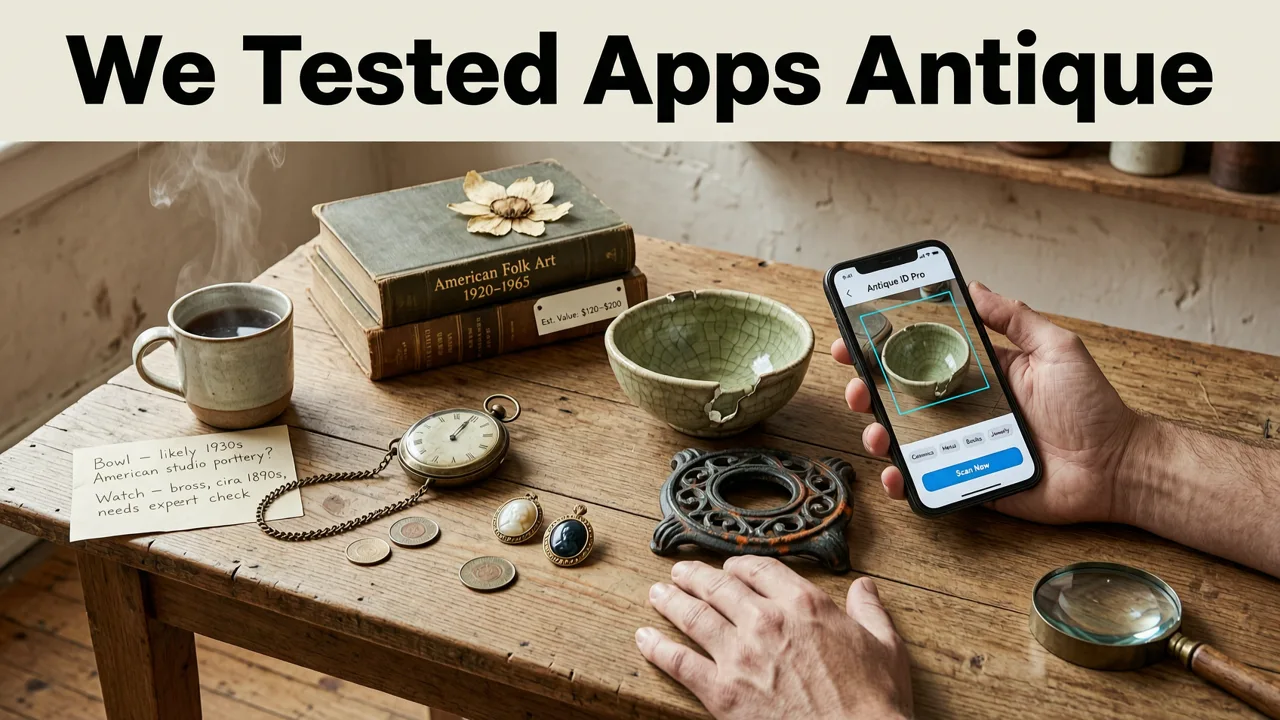
We evaluated each app against a shared test kit of 40 objects: vintage glassware, costume jewelry, silver flatware, pottery, books, and folk art. Every item was photographed under the same lighting conditions and submitted to each app three times. We scored on five criteria:
- Identification accuracy — correct maker, era, and pattern on the first scan.
- Value estimate reliability — how closely the app's range matched recent sold comps.
- Speed — average time from photo to result.
- Authentication depth — whether the app flags fakes, reproductions, or condition issues.
- Cost and ease of use — subscription price, free-tier limits, and onboarding friction.
The 7 Best Apps for Antique Identification and Value in 2026
1. Antique Identifier (AntiqueIdentifiers.com)
Antique Identifier is a purpose-built AI scanner for collectors, resellers, and estate shoppers. Point your camera at an object and the app returns a maker identification, approximate production era, hallmark or backstamp reading, and a resale-value range pulled from recent auction and marketplace data.
Best for: Thrift shoppers, estate-sale hunters, and anyone who needs a fast, confident read at the point of purchase.
- AI vision model trained on pottery marks, silver hallmarks, glass patterns, and jewelry stamps.
- Live value ranges tied to sold comps, not catalog guesses.
- Condition notes and authentication cues built into each result.
- Works offline for hallmark lookup once marks are cached.
For context on how app IDs line up with formal appraisals, see our Antique Appraisal Cost Guide: What to Expect in 2026.
2. Google Lens (Collectibles Mode)
Google Lens remains the most accessible free starting point. In 2026, its collectibles-specific mode surfaces visually similar listings, museum references, and Wikipedia entries for recognized patterns. It is excellent for a first pass on unfamiliar objects, especially vintage glassware patterns and mid-century decorative objects.
Best for: Casual identification, cross-referencing, and quick visual similarity searches.
- Free, no account required.
- Massive visual index drawn from public web content.
- Does not provide value estimates or authentication.
3. WorthPoint (Worthology)
WorthPoint has long been the database of record for serious resellers. The 2026 app layers a cleaner mobile interface on top of decades of auction and marketplace data. You can search by keyword, category, or uploaded photo, and the tool returns historical sold prices, trend charts, and comparable listings.
Best for: Resellers who need historical pricing context and long-trend data.
- Deep archive of sold listings going back years.
- Category-specific filters for glass, pottery, silver, toys, and more.
- Subscription-based; free tier is limited.
- Identification is manual — you still need to know what you are searching for.
4. Kovels Antiques App
Kovels brings its print price-guide authority into a mobile experience. The 2026 edition offers searchable entries across furniture, ceramics, glass, silver, jewelry, and collectibles, with editorial notes on reproductions and common fakes.
Best for: Collectors who want editorial context alongside price ranges.
- Trusted brand with decades of editorial oversight.
- Strong on American and European decorative arts.
- Price ranges skew toward retail; resale values may differ.
- Photo-based ID is less advanced than dedicated AI scanners.
5. Marks4Antiques
If your bottleneck is reading a tiny backstamp, hallmark, or maker's mark, Marks4Antiques is the specialist tool. Its database of pottery, porcelain, silver, and glass marks is among the most comprehensive available, and the 2026 app adds image-matching for worn or partial stamps.
Best for: Silver, pottery, and porcelain collectors who need mark-level identification.
- Largest dedicated mark database in consumer reach.
- Useful for partial or damaged marks.
- Value data is limited; pair with a pricing tool.
6. eBay App (Visual Search and Sold Listings)
eBay's 2026 visual search is surprisingly effective for collectibles. Snap a photo and the app returns active and sold listings for visually similar items. For resellers, the sold-listing filter is the fastest way to ground-truth a value estimate.
Best for: Resellers who plan to list on eBay anyway and want instant comp data.
- Free, with deep sold-listing history.
- Visual search works well on common collectible categories.
- Identification is crowd-sourced; accuracy varies.
7. Collectr (Community-Powered ID)
Collectr is a newer entrant that blends AI pre-identification with a community of expert volunteers. You submit a photo, the AI offers a probable ID, and verified collectors confirm, refine, or correct it within hours.
Best for: Obscure or regional pieces that trip up automated systems.
- Human-in-the-loop verification improves accuracy over time.
- Strong community for niche categories like folk art and regional pottery.
- Slower turnaround than pure AI tools.
Head-to-Head Comparison: Best Apps for Antique Identification and Value
| App | AI Photo ID | Value Estimates | Authentication Cues | Best Use Case | Price (2026) |
|---|---|---|---|---|---|
| Antique Identifier | Yes | Yes, sold-comps | Yes | Estate and thrift sourcing | Freemium |
| Google Lens | Yes (visual) | No | No | Quick first-pass ID | Free |
| WorthPoint | Limited | Yes, historical | No | Resale pricing research | Subscription |
| Kovels | Limited | Yes, retail ranges | Editorial notes | Collectors seeking context | Subscription |
| Marks4Antiques | Mark matching | No | Mark verification | Silver and pottery marks | Subscription |
| eBay App | Visual search | Yes, sold comps | No | Resellers pricing to list | Free |
| Collectr | AI + human | Limited | Community review | Obscure and regional pieces | Freemium |
What Makes an Antique Identification App Worth Paying For
Not every app in this space earns a subscription. After testing dozens, three features separate the tools collectors actually keep on their home screen from the ones they delete after a week.
Real Sold-Comp Pricing, Not Catalog Guesses
A value estimate is only useful if it reflects what buyers actually paid. The best apps for antique identification and value in 2026 pull from closed auction results and confirmed marketplace sales, not from printed price guides that lag the market by a year or more.
Maker-Mark and Backstamp Recognition
Most collectibles carry a small identifier — a hallmark, a backstamp, a molded mark — that is the single most reliable path to a correct ID. Apps that can read and match these marks, even when they are faint or partial, consistently outperform generic image-search tools.
Authentication and Reproduction Flags
The rise of high-quality reproductions means an app that only tells you what something might be is incomplete. Look for tools that flag common fakes, note which patterns have been reissued, and highlight condition issues that affect value.
How to Use an Antique ID App at an Estate Sale or Thrift Store
A fast workflow turns a good app into a real edge. Here is the routine we recommend in 2026:
- Scan the mark first. Before photographing the whole object, get a clean close-up of any backstamp, hallmark, or maker's mark. Most apps let you submit the mark as the primary image.
- Submit a full-object photo. Good, even lighting and a neutral background improve accuracy. Avoid flash glare on glass and silver.
- Read the app's confidence score. If the tool reports low confidence, treat the result as a lead, not a conclusion.
- Cross-check with a second source. A quick Google Lens search or a mark database lookup can confirm or correct the AI's read.
- Verify condition before pricing. Chips, hairlines, repairs, and fading can cut value dramatically. Factor these in before deciding what to pay.
For a deeper checklist on assessing whether a piece is actually worth buying, see How to Tell If an Antique Is Valuable: 7 Expert Checks for 2026.
Common Mistakes Collectors Make With ID Apps
Even experienced resellers fall into a few predictable traps when relying on apps for identification.
- Trusting a single scan. One app's ID is a hypothesis. Confirm with a second tool or a reference database before committing to a purchase.
- Ignoring condition. An app may price a piece in mint condition. If yours has a hairline or a repair, adjust accordingly.
- Confusing retail with resale. Some sources report retail or insurance values. If you plan to resell, use sold-comp data instead.
- Overlooking reissues. A pattern may be genuine but currently in production. App IDs do not always distinguish old from new without mark-level detail.
Which App Should You Choose in 2026?
The right tool depends on how you collect and sell.
- For fast point-of-purchase decisions at thrift stores and estate sales, an AI scanner like Antique Identifier gives you the quickest path from photo to confident read.
- For deep pricing research before listing, WorthPoint or eBay's sold-listing filter provides the most grounded resale data.
- For mark-heavy categories like silver and pottery, Marks4Antiques is the specialist reference.
- For casual curiosity or a first pass on an unfamiliar object, Google Lens is free and surprisingly capable.
If you are actively reselling, the strongest setup in 2026 pairs an AI identifier for on-the-spot decisions with a sold-comp database for listing research. See our roundup of 12 Best Antiques to Resell Online in 2026 for what to look for once your app flags a promising piece.
The Limits of AI Antique Identification
Even the best apps for antique identification and value have boundaries. AI models can misread worn marks, confuse visually similar patterns from different makers, and miss regional variations that only a specialist would catch. For high-value items — fine silver, signed paintings, important ceramics, and rare jewelry — an app scan is the starting line, not the finish.
When an object's estimated value crosses into four figures, invest in a formal appraisal from a certified specialist. The cost is modest relative to the upside of getting it right, and the documentation is essential for insurance, estate planning, and credible resale.
Final Thoughts
The best apps for antique identification and value in 2026 have turned what used to require a shelf of reference books and a trip to a specialist into a matter of seconds and a smartphone camera. Used wisely, they save you from passing over hidden gems and from overpaying for common pieces. Used carelessly, they can give you false confidence in a bad buy. The difference is verification: cross-check, inspect condition, and know when to call in a human expert.
Ready to put these tools to work on your next thrift run or estate sale? Download the Antique Identifier app and scan your first piece today — your next great find may already be sitting on a shelf, waiting for the right app to spot it.
Related resources
Frequently Asked Questions
Are antique identification apps accurate in 2026?
Top AI-powered apps correctly identify common collectibles — pottery patterns, silver hallmarks, glassware, and costume jewelry — on the first scan most of the time. Accuracy drops on rare, regional, or heavily worn pieces, so cross-check with a second source or a mark database before relying on a single result for purchasing decisions.
Which app gives the most accurate antique value estimates?
Apps that pull from real sold listings and closed auction results, such as Antique Identifier and WorthPoint, provide the most reliable value ranges in 2026. Printed price guides and retail-focused sources tend to run higher than actual resale prices.
Can an app tell if an antique is fake?
The best apps flag common reproductions and note authentication cues such as mold seams, transfer decals, and modern materials. However, no app replaces a trained specialist for high-value items — use app flags as a starting point and consult a certified appraiser when the stakes are high.
Do I need to pay for an antique identification app?
Free tools like Google Lens and the eBay app offer useful visual search and sold-comp data. Paid apps add dedicated maker-mark databases, AI-driven identification, and authentication features that save time and reduce errors for active collectors and resellers.
What is the best workflow for using an ID app at an estate sale?
Photograph any maker's mark or hallmark first, then submit a clean full-object photo to the app. Check the confidence score, cross-reference with a second tool or mark database, and adjust the app's value estimate for any condition issues before deciding what to pay.
Related Articles


Explore more practical antique identification and appraisal guides.
View all articles