Antique Furniture Maker Marks Database: 2026 Identification Guide
Explore the antique furniture maker marks database to identify makers, eras, and value. Learn how 2026 tools, visual search, and expert methods reveal hidden hallmarks.

Antique Furniture Maker Marks Database: The Short Answer
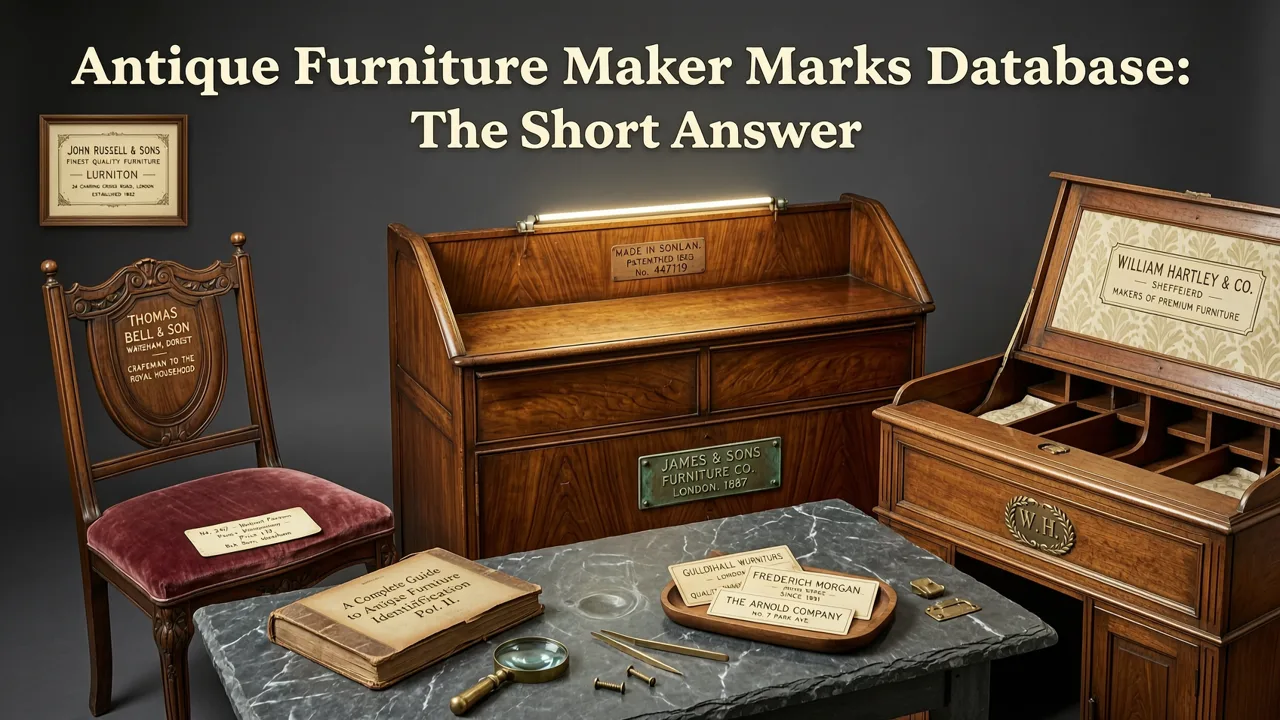
If you have ever flipped a chair, peered under a table, or squinted at a faint stamp inside a drawer, you already know why an antique furniture maker marks database matters. These small stamps, labels, and carved symbols are the closest thing furniture has to a fingerprint, and they can turn a mystery piece into a documented one. In 2026, the most useful databases combine traditional reference catalogs with AI-powered visual search, so you no longer need to own a shelf of printed guides to identify a maker, date a piece, or estimate its value.
The short answer is this: no single database covers every maker who ever lived, but a layered approach, using a trusted maker marks database alongside visual identification tools and a bit of historical context, will identify the majority of marked antique furniture you encounter. Below, you will learn how these databases work, which categories of marks to look for, how to cross-reference them, and when a printed mark actually changes the value of a piece.
Why the Antique Furniture Maker Marks Database Matters More in 2026
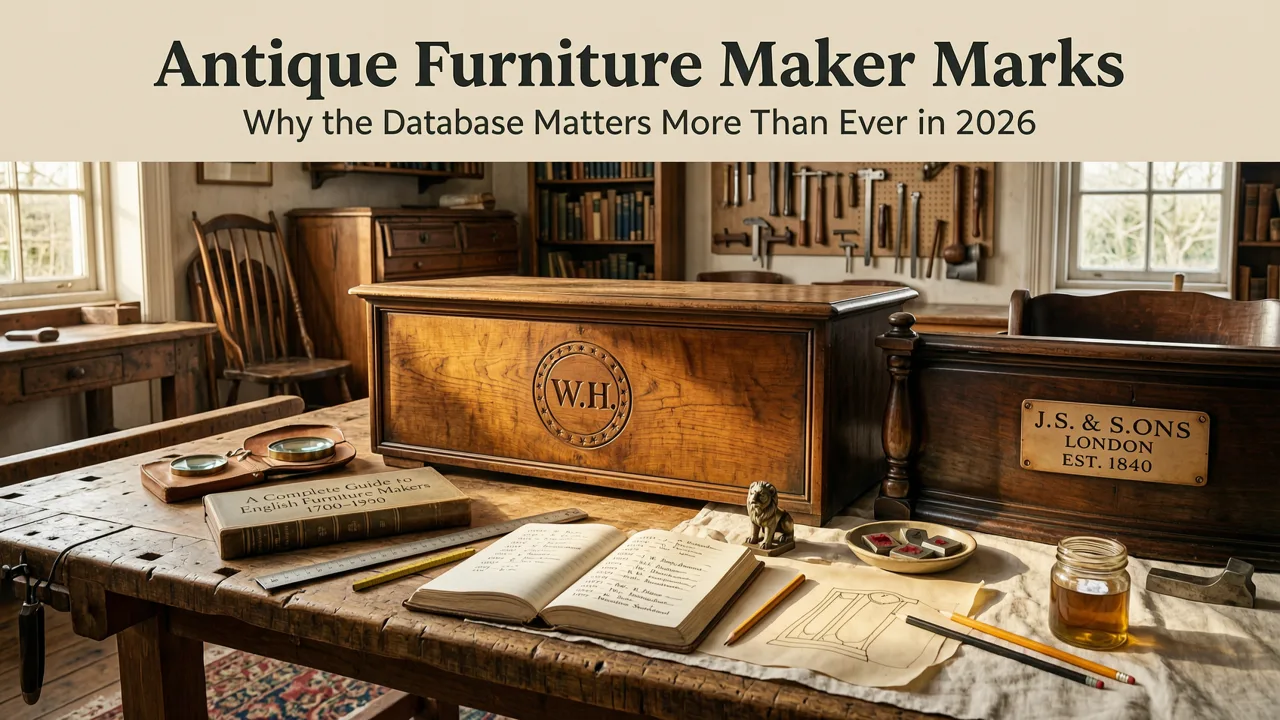
The antique market has shifted noticeably over the past few years. Buyers are more skeptical, auction records are publicly searchable, and AI-assisted identification has moved from novelty to everyday tool. That shift has made a reliable antique furniture maker marks database more important than ever, for three reasons.
- Authentication is the new baseline. With high-quality reproductions entering the market through online channels, collectors and resellers need documented maker marks to prove a piece is what it claims to be.
- Provenance adds value. A piece attributed to a known maker, confirmed through a marks database, often sells for significantly more than an identical unmarked piece.
- AI tools now read marks. Modern visual identification apps can compare a photo of a stamp against millions of reference marks, turning a confusing blur into a probable maker in seconds.
That said, a database is only as good as the information you feed it. Clear photos, accurate measurements, and a willingness to cross-reference multiple sources are what separate a confident identification from a hopeful guess.
Types of Furniture Maker Marks You Will Encounter
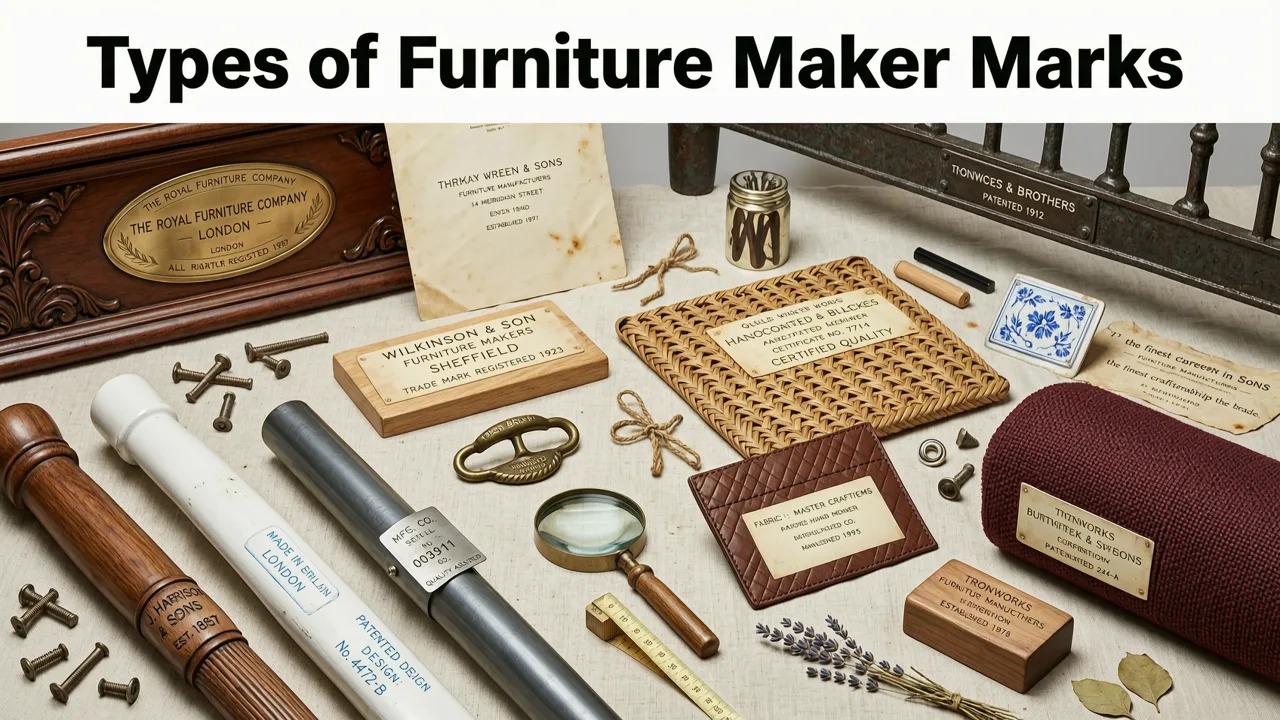
Before you open any database, it helps to know what you are looking for. Furniture maker marks are not standardized the way silver hallmarks are, which is both the challenge and the reason a database is useful. Here are the main categories you will see.
Stamped or Burned Marks
Common on American and British furniture from the 18th through early 20th centuries, these marks are often found on the back, underside, or inside a drawer. They may include the maker's name, city, and sometimes a date. Examples include the burned stamps of Gustav Stickley, the inked labels of Duncan Phyfe, and the impressed marks of London cabinetmakers.
Paper Labels and Stickers
Many 19th- and early 20th-century manufacturers used paper labels glued inside drawers or on the back of case pieces. These are fragile and often partially lost, which is why a database that catalogs partial marks is especially valuable. Faded remnants of a label from firms like Kimball & Co., A. H. Davenport, or W. & L. E. Gurley can still be matched in a well-maintained database.
Carved or Incised Marks
Higher-end European furniture, particularly French and Italian pieces, sometimes features carved maker initials or full names directly into the wood. These marks are more durable but also more difficult to photograph clearly, which is where visual search tools come in handy.
Metal Plates and Tags
From the late 19th century onward, many manufacturers used brass or tin plates screwed or nailed to the back of a piece. These are common on Victorian, Arts and Crafts, and early modern furniture. Metal plates often include the maker's name, city, and sometimes a patent date, which gives you a firm earliest-possible production year.
Hidden or Secondary Marks
Some makers used secondary marks that only appear under specific conditions. Chalk marks on the back of a drawer, pencil notations on the underside of a seat rail, or even tooling patterns on the back panel can all point to a specific workshop. A good database will note these secondary identifiers alongside primary marks.
How to Use an Antique Furniture Maker Marks Database Effectively
Opening a database and typing in a name is the simplest use case, but it is rarely the most productive one. Here is a step-by-step approach that works well in 2026.
Step 1: Photograph the Mark Clearly
Use natural light, a neutral background, and a macro lens or a phone with a good close-up mode. Include a coin or ruler in the frame for scale. If the mark is faint, try raking light from a flashlight held at a low angle to bring out stamped or carved detail.
Step 2: Note the Construction Clues
Before you search, record what you see. Is the piece dovetailed by hand or machine? Does it use square nails, cut nails, or screws? What kind of wood is it? These details narrow the date range and help you confirm whether a database match makes sense.
Step 3: Search the Database by Visual and Text Filters
Most modern databases let you search by keyword, country, era, or by uploading an image. Start broad. If a stamped mark reads partially, try searching for the legible letters plus the country of origin. If you are using a visual search tool, upload the clearest photo you have and review the top matches carefully.
Step 4: Cross-Reference With Secondary Sources
A database match is a strong lead, not a final verdict. Confirm it against printed reference books, auction records, and museum collections. If a piece is attributed to a specific maker, you should be able to find comparable documented examples.
Step 5: Document Everything
Keep a record of the mark, the database match, the supporting evidence, and your final attribution. This documentation is what separates a casual guess from a defensible identification, and it becomes essential if you ever need a formal appraisal.
Antique Furniture Maker Marks Database: Major Reference Sources in 2026
There is no single universal database, but several resources are widely trusted by collectors, dealers, and appraisers. Here is how the major options compare.
| Resource | Type | Strengths | Limitations |
|---|---|---|---|
| AI-Powered Visual Identifier Apps | Image recognition with database lookup | Fast, works from a phone, matches partial or worn marks | Can return false positives on very common marks |
| Printed Maker Mark Encyclopedias | Book-based catalogs | Deep historical context, reliable attributions | Not searchable by image, updates slowly |
| Museum and Archive Collections Online | Institutional databases | High-confidence documented examples | Limited to pieces in their collections |
| Auction House Archives | Sales records with maker attributions | Real-world market data, recent sales | Attributions are not always independently verified |
| Specialist Forums and Collector Groups | Community knowledge | Niche expertise, regional knowledge | Quality varies, not a substitute for primary sources |
The most effective approach in 2026 is to combine at least two of these. An AI-powered app can give you a quick lead, a printed reference can confirm the historical context, and an auction archive can show you what comparable pieces are actually selling for. If you are just getting started, the best apps for antique identification are a strong first step because they let you photograph a mark and get results in seconds.
Regional Differences in Furniture Maker Marks
Marks vary significantly by country and era, and a good database will organize them accordingly. Here are the broad patterns you will see.
British Furniture Marks
British cabinetmakers from the 18th and 19th centuries often used stamped or labeled marks, particularly in London, Edinburgh, and Dublin. The Dictionary of English Furniture Makers remains the gold-standard reference, and many online databases draw from it. Look for marks inside drawers, on the back of case pieces, and on the underside of chair seats.
French Furniture Marks
French makers used the estampille, a stamped mark that was legally required after 1743. These marks are often small, worn, and located on visible surfaces, which means they were sometimes deliberately obscured or removed. A database that catalogs partial estampilles is invaluable.
American Furniture Marks
American marks range from the hand-labeled pieces of 18th-century Philadelphia and Boston cabinetmakers to the mass-produced stamped and labeled furniture of the late 19th and early 20th centuries. Makers like Stickley, Limbert, and Grand Rapids manufacturers are well-documented, but many regional makers are only partially cataloged.
Continental European Marks
German, Austrian, Italian, and Scandinavian makers each have their own traditions. Scandinavian marks from the mid-20th century are often clean and legible, while older Continental pieces may use carved initials or workshop symbols that require specialist knowledge to decode.
When a Maker Mark Actually Changes the Value
A maker mark is exciting to find, but it does not automatically mean a piece is valuable. Here is how to think about the relationship between marks and value.
- A confirmed mark from a sought-after maker adds value. A piece attributed to Thomas Chippendale, George Hepplewhite, or Gustav Stickley will sell for more than an unmarked piece in similar condition, assuming the attribution is defensible.
- A mark from an unknown maker rarely adds value on its own. It may help with dating and provenance, but it will not move the price significantly unless the piece itself is desirable.
- A fake or misleading mark reduces value. If a mark is determined to be a later addition or a deliberate forgery, it can hurt the piece's value and credibility.
- Condition still matters most. A marked piece in poor condition will generally sell for less than an unmarked piece in excellent condition, unless the maker is exceptionally rare.
If you are trying to understand what a marked piece is actually worth in today's market, the 2026 guide to antiques worth money covers current buyer preferences and realistic pricing across categories.
Common Mistakes When Using a Maker Marks Database
Even experienced collectors make errors when relying too heavily on a single source. Watch out for these pitfalls.
Assuming Every Mark Is Original
Labels can be moved, stamps can be faked, and metal plates can be swapped. Always check whether the mark is consistent with the construction, materials, and wear patterns of the piece.
Ignoring Partial or Worn Marks
A faded label or a partially legible stamp is still useful. Many databases include partial matches, and a visual search tool may recognize a mark that is unreadable to the naked eye.
Relying on a Single Source
A database match is a starting point, not a conclusion. Cross-reference with at least one other source before making a final attribution.
Overlooking Secondary Identifiers
Construction details, hardware, and materials can confirm or contradict a mark-based attribution. A piece marked as 18th century but built with machine-cut dovetails and wire nails is almost certainly a later reproduction.
How AI-Powered Tools Are Changing Mark Identification in 2026
The biggest shift in antique identification over the past few years is the rise of AI-powered visual search. These tools use image recognition to compare a photo of a mark against large reference databases, returning probable matches ranked by confidence.
This does not replace traditional research, but it dramatically speeds up the first step. A mark that might have taken hours to identify in a printed catalog can now be matched in seconds. The key is to treat the AI result as a strong lead and then verify it with secondary sources, just as you would with any other database match.
Responsible AI tools follow clear guidelines around accuracy and transparency. Google's AI responsibility principles and OpenAI's documentation both emphasize the importance of explaining how results are generated and acknowledging uncertainty, which is exactly the right approach for antique identification.
Building Your Own Maker Marks Reference Library
If you identify furniture regularly, you will eventually want a personal reference library that goes beyond what any single database provides. Here is a practical starter set.
- A general maker marks encyclopedia. A printed reference that covers multiple countries and eras gives you a broad foundation.
- Regional specialist books. If you focus on American Arts and Crafts, French Art Deco, or British Georgian furniture, get the specialist reference for that niche.
- An AI-powered identification app. For fast, on-the-spot identification when you are out shopping or at an estate sale.
- A notebook or digital log. Record every mark you encounter, even the ones you cannot identify. Over time, this becomes your own personal database.
- Auction archives. Bookmark the search tools of major auction houses so you can quickly check recent sales of comparable pieces.
If you are also collecting smaller items like glassware, the vintage glassware identification guide covers marks, patterns, and eras for that category as well.
Frequently Asked Questions
Is there a free antique furniture maker marks database?
Several free online resources include maker marks, but they vary in depth and reliability. Museum collections, auction house archives, and community forums offer free access to documented marks. For the fastest results, AI-powered identification apps often include free tiers that let you search a limited number of marks per month.
How accurate are AI furniture mark identifiers?
Modern AI tools are surprisingly accurate on clear, well-lit photos of common marks, often returning the correct maker on the first or second try. Accuracy drops on worn, partial, or very rare marks, which is why cross-referencing with printed sources and auction records remains important.
Where are maker marks usually located on antique furniture?
Common locations include the back of case pieces, the underside of tables and chairs, the inside of drawers, the back of seat rails, and the underside of table leaves. Always check multiple locations, as some makers used more than one mark on a single piece.
Can a maker mark be faked?
Yes. Labels can be reproduced, stamps can be copied, and metal plates can be added to unrelated pieces. Always check whether the mark is consistent with the piece's construction, materials, age, and wear patterns before relying on it for attribution or valuation.
Start Identifying With Confidence
An antique furniture maker marks database is one of the most practical tools a collector, reseller, or estate owner can use. It turns mystery pieces into documented ones, supports confident buying and selling, and helps you build a collection with real provenance. In 2026, the combination of AI-powered visual search and traditional reference sources makes identification faster and more reliable than ever before.
The next time you find a piece with a faint stamp, a faded label, or a carved initial, do not leave it to guesswork. Photograph the mark, run it through a trusted identifier, and cross-reference the results. If you want to try it right now, open the Antique Identifier app and let AI help you turn that small mark into a clear answer.
Frequently Asked Questions
Is there a free antique furniture maker marks database?
Several free online resources include maker marks, including museum collections, auction house archives, and community forums. AI-powered identification apps often include free tiers that let you search a limited number of marks per month, making them a practical starting point for casual collectors.
How accurate are AI furniture mark identifiers in 2026?
Modern AI tools are highly accurate on clear, well-lit photos of common marks, often returning the correct maker on the first or second try. Accuracy decreases on worn, partial, or very rare marks, which is why cross-referencing with printed sources and auction records remains important for confident attribution.
Where are maker marks usually located on antique furniture?
Common locations include the back of case pieces, the underside of tables and chairs, the inside of drawers, the back of seat rails, and the underside of table leaves. Always check multiple locations, as some makers used more than one mark on a single piece.
Can a furniture maker mark be faked?
Yes. Labels can be reproduced, stamps can be copied, and metal plates can be added to unrelated pieces. Always check whether the mark is consistent with the piece's construction, materials, age, and wear patterns before relying on it for attribution or valuation.
Does a maker mark always increase a piece's value?
Not always. A confirmed mark from a sought-after maker typically adds value, but a mark from an unknown maker rarely moves the price on its own. Condition, rarity, and current buyer demand still matter more than the mark alone.
Related Articles


Explore more practical antique identification and appraisal guides.
View all articles