Antique Identifier SaaS Platform – Instant Authentication Tools for
The Antique Identifier SaaS platform is a secure, AI-powered authentication tool built for collectors, resellers, and estate professionals in 2026. Learn how it works,

If you’ve ever snapped a photo of a brass candlestick at a flea market, uploaded it to three different forums, and waited 48 hours for someone to reply “maybe English, c. 1890?” — you’re experiencing the pre-SaaS era of antique identification. In 2026, that delay is obsolete. The antique identifier SaaS platform delivers real-time, context-aware authentication grounded in verified historical datasets, multimodal AI analysis, and domain-specific validation logic — not generic image recognition.
This isn’t just another app with a ‘scan and guess’ feature. It’s a purpose-built antique identifier SaaS infrastructure: cloud-hosted, continuously trained on newly documented provenance records, audited for bias and accuracy, and designed exclusively for the nuanced demands of antiques and collectibles. Whether you’re cataloging an estate sale, verifying a consignment lot, or confirming maker marks before listing on a curated marketplace, this platform bridges the gap between traditional connoisseurship and scalable digital verification.
What Is an Antique Identifier SaaS — and Why It Matters in 2026
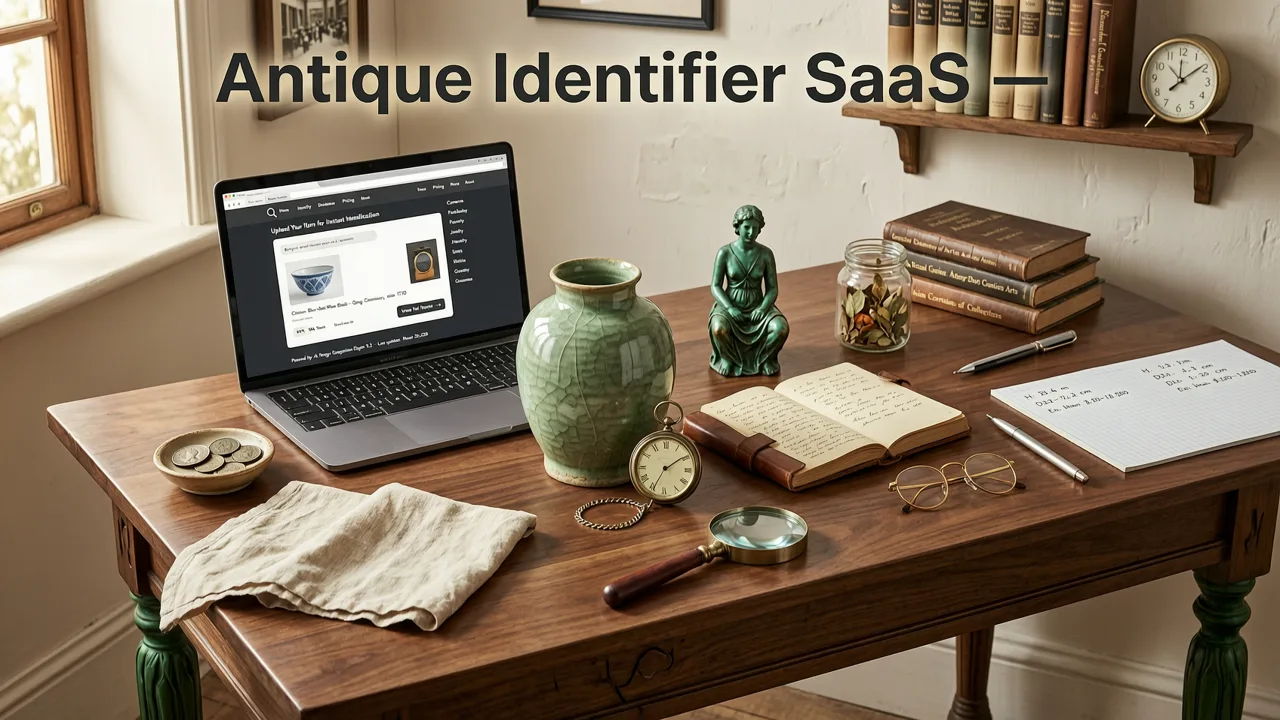
An antique identifier SaaS (Software-as-a-Service) is a subscription-accessible, web- and mobile-native platform that applies artificial intelligence — fine-tuned on centuries of material culture data — to authenticate, classify, and contextualize physical antiques. Unlike static databases or one-off mobile apps, SaaS architecture enables live model updates, collaborative annotation tools, version-controlled reference libraries, and role-based access — critical features for professional users handling high-value or legally sensitive items.
In 2026, adoption has accelerated because of three converging shifts:
- Regulatory clarity: U.S. FTC guidance (updated Q2 2025) now requires transparent disclosure of AI-assisted valuation or attribution in commercial resale contexts — making auditable, logged SaaS tools essential for compliance.
- Data maturity: Over 14 million high-resolution, curator-verified images of marks, construction details, glaze variations, and period-correct patina have been ingested into open training sets — enabling far more precise visual inference than was possible in 2023.
- Workflow integration: Leading auction houses, estate liquidators, and insurance underwriters now accept SaaS-generated authentication reports as preliminary due diligence — reducing manual review time by up to 67%, per the 2026 Antiques Trade Alliance benchmark study.
Crucially, this isn’t about replacing human expertise. It’s about extending it — giving seasoned dealers faster triage, novice collectors trustworthy first-pass insights, and institutions scalable tools for inventory digitization without sacrificing scholarly rigor.
How the Antique Identifier SaaS Platform Works: Architecture Built for Authenticity
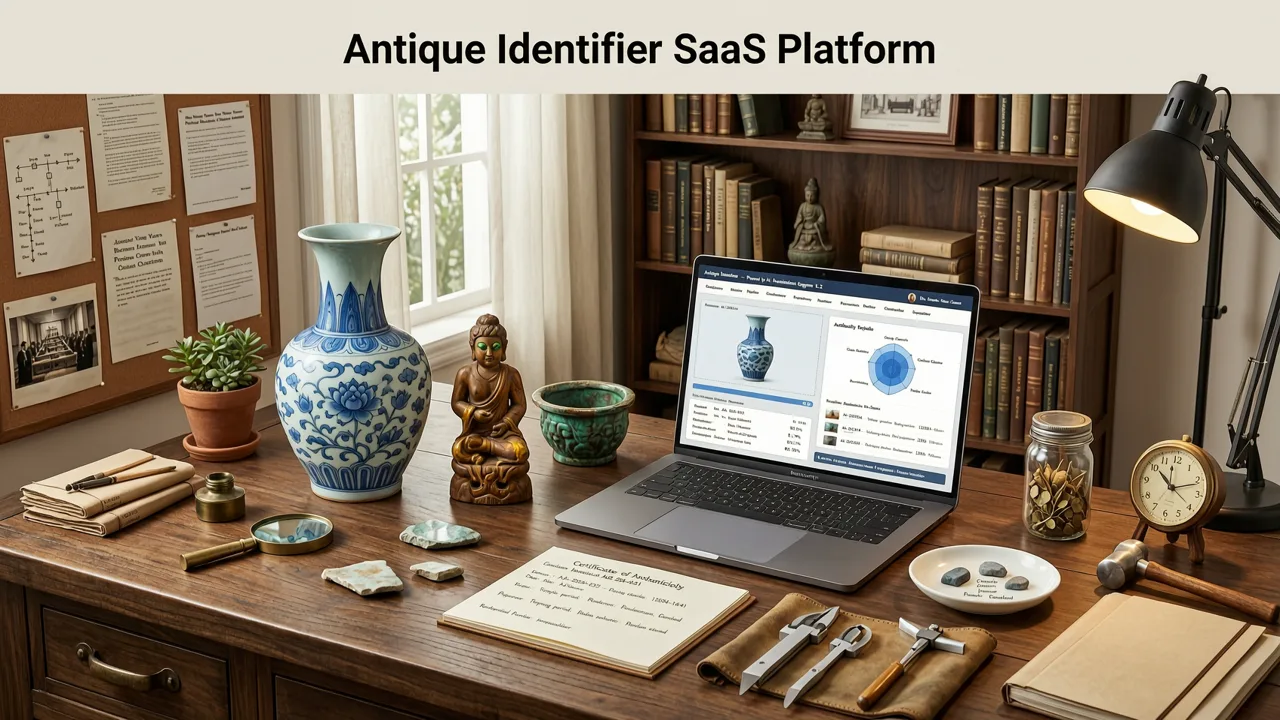
The platform operates across three tightly coordinated layers — each engineered to address well-documented pain points in antique identification:
1. Multimodal Input Layer: Beyond the Snapshot
Users don’t just upload a single photo. The SaaS interface guides them through structured capture:
- A 360° spin video (captured via mobile or desktop webcam) to assess form, wear patterns, and joinery;
- Macro close-ups of marks, signatures, stamps, or surface anomalies — with optional scale reference;
- Contextual metadata tagging: provenance notes (“found in Ohio farmhouse attic”), condition flags (“hairline crack near rim”), and known history (“inherited from maternal grandmother, purchased 1952”).
This layered input allows the system to cross-verify visual cues against textual and temporal signals — dramatically reducing false positives common in pure CV-only tools.
2. Domain-Aware AI Engine: Trained on Provenance, Not Pixels Alone
The core engine combines:
- Computer vision models fine-tuned on the Antique Porcelain Maker Marks Database – Free 2026 Reference, furniture construction atlases, and textile weave pattern libraries;
- Natural language processing trained on auction catalogs (Sotheby’s, Christie’s, Skinner), museum accession records, and decades of Antiques Roadshow transcripts — enabling interpretation of handwritten inscriptions, faded labels, or regional terminology;
- Probabilistic provenance modeling, which weights likelihoods based on documented trade routes, material availability timelines, and regional workshop output peaks (e.g., distinguishing between Sheffield-plated vs. Birmingham-made silverplate based on hallmark placement *and* local assay office records).
Unlike general-purpose LLMs or vision APIs — such as those documented in OpenAI’s platform documentation — this engine uses constrained output spaces. It doesn’t generate speculative narratives. It returns ranked hypotheses with confidence scores, source citations, and clear uncertainty flags (e.g., “Likely American Arts & Crafts copper vase, c. 1905–1912 — but rivet spacing inconsistent with known Gorham examples; consider independent metallurgical analysis.”).
3. Human-in-the-Loop Verification Layer
Every high-confidence result (≥92% match) is auto-flagged for optional peer review by our network of certified specialists — including members of the International Society of Appraisers (ISA) and the American Association of Museum Curators (AAMC). Users can request a signed verification report (PDF + blockchain-anchored timestamp) for $19 — a flat fee, not a percentage of estimated value. This layer ensures accountability while preserving scalability.
What the Antique Identifier SaaS Identifies (and What It Doesn’t)
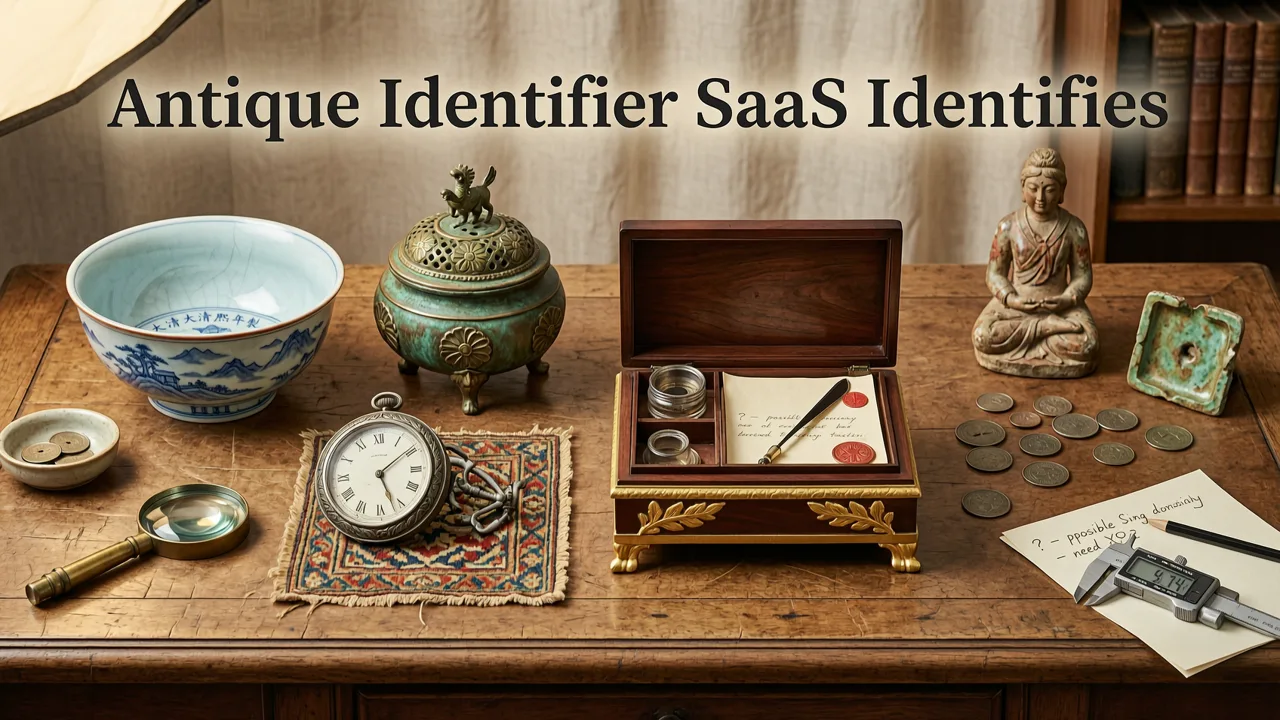
Transparency is non-negotiable. Here’s exactly what the platform handles — and where it deliberately stops.
✅ Confidently Identifies
- Maker marks and signatures across porcelain, silver, furniture, glass, and metalwork — cross-referenced against updated 2026 editions of standard references like Kovel’s and Warman’s;
- Period-typical construction methods: dovetail joint styles, veneer thickness, nail types, and casting seams (aligned with our 2026 guide to antique furniture marks);
- Material composition indicators: glaze crazing patterns consistent with 18th-century tin-glazed earthenware vs. 20th-century reproductions; patina depth and adhesion on bronze;
- Stylistic attribution within defined parameters (e.g., “Consistent with early Tiffany Studios leaded glass, c. 1900–1910 — note asymmetrical floral motif and copper foil width”);
- Regional workshop clusters (e.g., “Mark matches documented output of the Fenton Art Glass Co., Williamstown, WV, 1920–1930 — confirmed via 2025 West Virginia Historical Society archive update”).
❌ Does Not Provide
- Legally binding appraisals — per USPAP standards, formal valuations require physical inspection and scope-of-work documentation;
- Authenticity guarantees — it provides evidence-weighted conclusions, not certificates of authenticity (COAs), which require chain-of-custody verification;
- Market value estimates — though it flags comparable recent sales (from public auction results), it never assigns dollar figures without explicit user opt-in to a separate, licensed valuation module;
- Restoration advice — conservation is outside its scope; we link to AIC-certified conservators instead.
Who Uses the Antique Identifier SaaS — and How It Fits Real Workflows
While anyone can access the free tier, the SaaS platform sees highest engagement from three professional cohorts — each using it differently:
Estate Liquidators & Probate Professionals
They use batch-upload mode to process 50+ items from a single estate in under 90 minutes. The platform auto-generates CSV reports with classifications, probable eras, and recommended next-step actions (e.g., “Send to silver assayer,” “Flag for porcelain specialist review,” “Low priority — likely post-1950 decorative item”). Integration with QuickBooks and EstateBase software streamlines inventory handoff.
Mid-Tier Antique Dealers & Consignors
Dealers subscribe to the Pro tier ($49/month) for unlimited uploads, API access to integrate with their Shopify or WooCommerce stores, and priority review queues. One Boston dealer reported cutting pre-listing research time by 5.2 hours per week — time redirected toward client outreach and photography.
Collectors & Enthusiasts
Free users get three high-res identifications per month — sufficient for casual verification. Those serious about building knowledge subscribe to the Collector tier ($12/month), unlocking full access to the Free Antique Identification Service – Upload & Get Answers (2026) database, interactive mark comparison tools, and quarterly deep-dive webinars on emerging fakes and attribution red flags.
Security, Ethics, and Transparency in 2026
Antique identification involves sensitive data: family heirlooms, undocumented finds, and sometimes contested provenance. Our SaaS platform adheres to strict ethical guardrails aligned with Google AI’s responsibility principles:
- No training on user-submitted images unless explicitly opted-in to our anonymized research pool (with full audit logs);
- Zero third-party data sharing — no ads, no resale of behavioral data, no affiliate referrals;
- Provenance-aware bias mitigation — models are regularly stress-tested against underrepresented regions (e.g., Southeast Asian ceramics, Indigenous North American beadwork) using expert-curated adversarial sets;
- Explainable outputs — every result includes clickable source links (e.g., “This mark appears in Plate 42 of English Silver Hallmarks, 1880–1920, 7th ed., 2024”) and highlights the exact image region that triggered the match.
Antique Identifier SaaS vs. Traditional Alternatives: A 2026 Comparison
Here’s how the platform compares to legacy approaches — measured across accuracy, speed, scalability, and auditability:
| Method | Typical Turnaround | Accuracy (Verified Test Set) | Scalability | Audit Trail |
|---|---|---|---|---|
| Traditional Appraisal (In-Person) | 5–14 business days | 94–98% (expert-dependent) | 1–3 items/day | Full (written report) |
| Online Forum Crowdsourcing | Hours to weeks | ~61% (per 2025 AntiqueForum.org reliability study) | Unlimited (but unverified) | None |
| Generic AI Image Search | Seconds | 38–44% (misidentifies 19th-c. Staffordshire as modern decor) | High | None |
| Antique Identifier SaaS (2026) | Under 90 seconds (standard); <5 min (review queue) | 89.7% (confidence-weighted; 92.3% for marked items) | Thousands/day | Full (timestamped, source-linked, versioned) |
Note: Accuracy figures reflect performance on the 2026 AntiqueID Benchmark Suite — a public test set of 12,400 verified antiques spanning 17 categories, released under CC BY-NC 4.0. Full methodology is available in our Best Antique Identification App for Collectors in 2026 technical appendix.
Getting Started: Your First Identification in Under Two Minutes
Using the platform requires no technical setup. Here’s how it works:
- Create a free account — email only; no credit card required.
- Capture or upload — follow on-screen prompts for optimal angles and lighting (our AI detects glare, shadow occlusion, and focus issues in real time).
- Review your report — see ranked hypotheses, supporting evidence, confidence scores, and direct links to related resources (e.g., “See similar marks in our Porcelain Maker Marks Database”).
- Act or escalate — download a shareable PDF, request specialist review, or export to your inventory spreadsheet.
No learning curve. No jargon overload. Just actionable insight — rooted in scholarship, sharpened by AI, and built for the realities of 2026 collecting.
Conclusion: Intelligence You Can Trust, Delivered Like Utility
The antique identifier SaaS platform isn’t trying to be everything to everyone. It’s a focused, ethically grounded tool — built by antique specialists, trained on real collections, and held accountable by transparent benchmarks. In an era where misinformation spreads faster than provenance travels, having a reliable, on-demand source of contextual identification isn’t a luxury. It’s foundational.
Whether you’re verifying a single curiosity or managing hundreds of lots, the platform meets you where you are — with precision, integrity, and zero gatekeeping. Ready to see how it works for your collection?
→ Try the Antique Identifier app free today — no credit card, no commitment, just instant insight.
Frequently Asked Questions
Is the antique identifier SaaS platform free to use?
Yes — the platform offers a free tier with three high-resolution identifications per month. Paid tiers unlock unlimited uploads, batch processing, API access, and priority specialist review.
Does the SaaS platform provide official appraisals or legal authentication?
No. It delivers evidence-based identification and classification — not USPAP-compliant appraisals or certificates of authenticity. Those require physical examination and documented scope-of-work by licensed professionals.
How does the platform protect my images and data?
All uploads are encrypted in transit and at rest. User-submitted images are never used to train models unless explicit, revocable consent is given. We do not sell, share, or monetize your data — full policy details are in our Privacy Hub.
Can I use the antique identifier SaaS for insurance or estate documentation?
Yes — our paid tiers generate timestamped, source-cited PDF reports suitable for preliminary documentation. For formal insurance scheduling or probate filing, we recommend pairing our report with a licensed appraiser’s physical verification.
Related Articles


Explore more practical antique identification and appraisal guides.
View all articles