Antiques Roadshow Common Fakes: How to Spot Them in 2026
Antiques Roadshow common fakes explained: reproduction lamps, fake porcelain marks, altered silver, and married furniture — plus checks to run before you buy.
On this page

The most costly mistake in collecting is not overpaying for an old piece — it is paying anything at all for something that was never old. The antiques roadshow common fakes that appraisers flag again and again fall into a short, predictable list: reproduction art glass and lamps, porcelain with borrowed reign marks, silverplate presented as sterling, married or cut-down furniture, refinished watches, and printed signatures sold as autographs.
Once you recognise those categories, the checks become routine. This guide explains what to look at, what to ignore, and how to confirm a suspicion before money changes hands. It is an independent collector resource and is not affiliated with any television programme.
What “Antiques Roadshow Common Fakes” Really Means
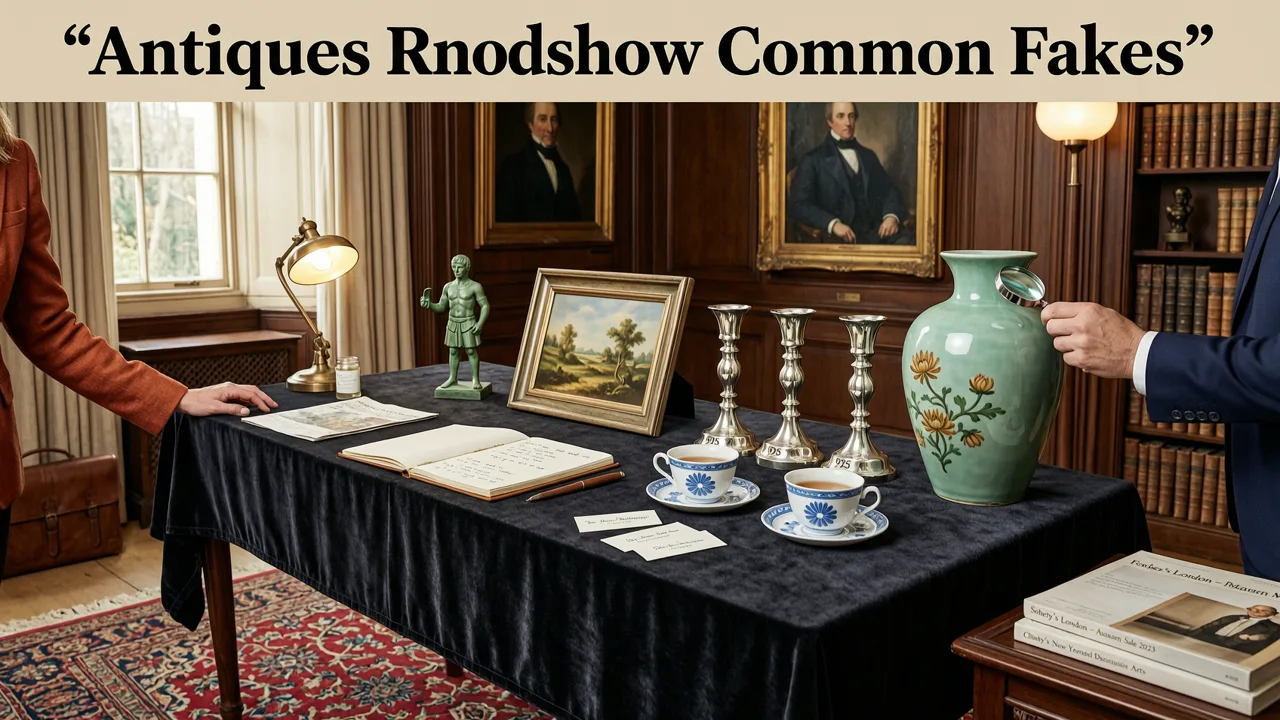
Most disappointing appraisals are not about criminal masterminds. They are about honest objects that lost their context somewhere along the way — a 1930s reproduction lamp inherited as “the original”, a plated tea set described as sterling by a well-meaning relative, a chest whose top and base met for the first time in a dealer’s workshop.
That distinction matters because the vocabulary drives the value. Four labels do most of the work.
Reproduction, forgery, marriage, restoration
- Reproduction: a later copy made for decoration or nostalgia, often sold openly as a copy when new. It becomes a problem only when someone relabels it.
- Forgery or fake: a copy made to deceive, usually with an added signature, hallmark, or maker’s stamp that was never authorised.
- Marriage: two genuine but unrelated parts joined into one “complete” piece — a period lid on a different jar, a genuine base under a replacement shade.
- Restoration or alteration: honest repair that has been hidden. A cut-down cabinet, a relined painting, or a repainted dial can be authentic and still worth far less than an untouched example.
A fifth category is the fantasy piece: an object in a style the original maker never produced. No amount of correct-looking material saves it, because the design itself is wrong.
The Categories That Turn Up Again and Again
Counterfeiting follows money. Wherever a name or a mark carries a premium, copies cluster around it. These are the fields where careful looking pays off fastest.
Tiffany-style lamps and art glass
Leaded glass shades were copied throughout the twentieth century, and many copies were legitimate products in their own right. Trouble starts when a stamped signature is treated as proof.
- Study the glass itself: period art glass usually shows depth, streaking, and mottling that varies pane to pane. Flat, uniform, machine-regular sheets are a warning.
- Check the metal. Bronze bases should show logical wear on high points and darker residue in recesses. An even, spray-like “patina” over untouched edges suggests applied finish.
- Look for a marriage. A correct base with a later shade is common, and the joint, cap, and hardware often betray the mismatch.
- Inspect sockets, wiring, and heat rings. Replacement electrical parts are normal; brand-new hardware on a supposedly untouched lamp is not.
On blown glass, a ground and polished pontil, tool marks, and slight asymmetry are consistent with hand work. A later acid-etched or engraved signature sitting on top of heavy wear deserves scrutiny.
Chinese and European porcelain
Reign marks are the single most misunderstood feature in ceramics. For centuries, potters wrote earlier emperors’ marks as a sign of respect or aspiration, so an apocryphal mark is not automatically a forgery — but a modern piece using one is.
- Under a loupe, transfer-printed decoration breaks into dots or a fine screen. Hand-painted enamel shows brush direction, pooling, and slight hesitations.
- Feel the footrim. Grit, kiln sand, and honest firing irregularities are hard to fake convincingly; a suspiciously smooth, uniformly white foot on a “very old” piece is a flag.
- Read country-of-origin labels literally. United States tariff rules from the 1890s onward required imported goods to be marked with their country of origin, so a “Made in China” stamp on something claimed as eighteenth century settles the question.
- Shine a long-wave UV torch in a dark room. Many fills, overpaints, and adhesives fluoresce differently from original glaze, revealing repairs the eye misses.
Silver, silverplate, and hallmarks
Here the fakes are usually about metal content rather than age. Electroplated wares have been made in enormous quantities since the nineteenth century, and abbreviations such as EPNS or EPBM describe plating, not solid silver.
- Learn the difference between a hallmark (an assay guarantee of fineness), a maker’s mark, and a pattern or trade stamp. Only the first speaks to metal purity.
- Use a small magnet. Silver is not magnetic, so a firm pull points to a plated base metal or a steel component. No pull proves nothing on its own.
- Compare wear and marks. Crisp, sharp hallmarks inside a heavily worn well are inconsistent; so are marks that sit at odd angles or spacing compared with documented examples.
- Watch for cast copies. Casting softens fine detail and leaves faint seam lines or pitting where chasing and hand-finishing should be.
- Remember weighted and filled pieces. Candlesticks with loaded bases and hollow filled handles can be genuine sterling and still contain very little silver.
Furniture marriages and cut-downs
Furniture is faked by arithmetic: take two damaged pieces, make one attractive one. Construction evidence is far harder to disguise than surface colour.
- Dovetails: hand-cut joints are irregular in size and spacing; uniform machine-cut joints point to later production.
- Fasteners: Phillips-type screws and plywood belong to the twentieth century. Finding them in a “seventeenth-century” carcass is decisive unless a documented repair explains them.
- Secondary wood: drawer bottoms, backs, and runners should show oxidation and shrinkage consistent with the front. Bright new timber inside an “old” case is a marriage clue.
- Tool and saw marks: straight saw marks, circular arcs, and machine planing each belong to different eras.
- Geometry: check whether screw holes, mouldings, and profiles line up. Cut-down pieces often have proportions that feel slightly wrong.
Watches and jewellery
Value here concentrates in originality. A refinished dial can look cleaner and be worth substantially less, because collectors pay for untouched printing and correct fonts.
- Look for mismatched case and movement references, service replacement hands, and polished cases with softened edges.
- On signed jewellery, examine the stamp quality: authorised marks are struck cleanly and consistently, while copied stamps often look shallow, doubled, or crowded.
- Synthetic gemstones have existed commercially since the early twentieth century, so “old” does not mean “natural”. Gemmological testing is a separate discipline from dating.
Autographs, prints, and paintings
Paper is the easiest medium to fake and the easiest to check with magnification.
- Autopen and stamped signatures show a uniform, mechanical ink line without natural pressure variation. Printed signatures break into dots under a loupe.
- Offset reproductions of “original” prints show a regular dot screen; genuine lithographs, etchings, and engravings have distinct, continuous ink structures and, for intaglio work, a plate mark.
- Artificial ageing — tea staining, uniform foxing, trimmed margins, fresh paper edges under old mounts — rarely survives side-by-side comparison with documented examples.
Red-Flag Reference Table
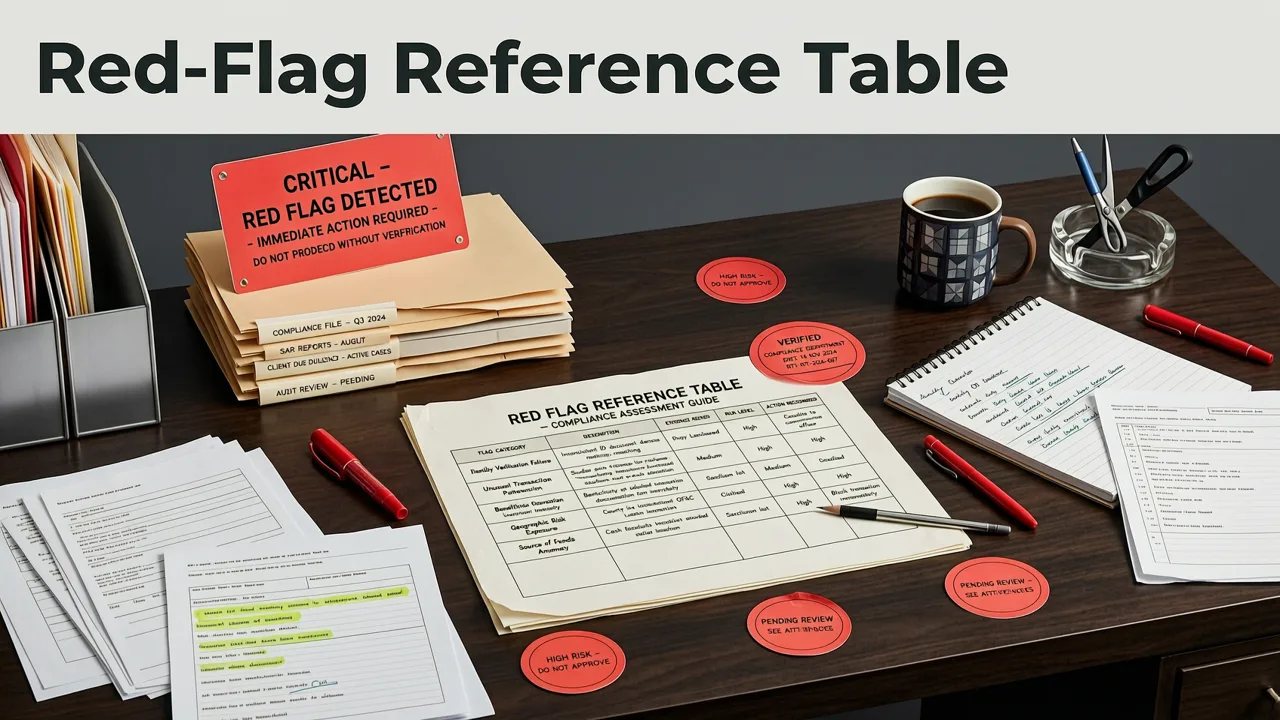
Use this as a triage sheet. A single flag is a reason to look harder; several flags together are a reason to walk away or renegotiate.
| Category | What usually turns up | 30-second red flag | Stronger confirmation |
|---|---|---|---|
| Leaded glass lamps | Reproduction shades, married base and shade | Uniform glass, even sprayed patina, new hardware | Glass character, base casting detail, joint and cap fit |
| Porcelain | Apocryphal reign marks, printed decoration | Dot screen under loupe, “Made in China” stamp | Footrim texture, enamel depth, UV check for overpaint |
| Silver | Plate sold as sterling, added marks | EPNS or EPBM stamps, magnetic pull | Full hallmark set, wear consistency, weight and dimensions |
| Furniture | Marriages, cut-downs, replaced parts | Machine dovetails, plywood, Phillips screws | Secondary wood oxidation, saw marks, hole alignment |
| Watches | Refinished dials, mixed service parts | Blurry dial printing, mismatched references | Movement and case numbers, specialist archive check |
| Autographs and prints | Autopen, printed signatures, reproductions | Mechanical ink line, dot pattern | Comparison with authenticated exemplars, paper analysis |
A Step-by-Step Check You Can Run at Home
Authentication is a sequence, not a hunch. Work in this order and you will avoid the classic error of falling in love with a mark before examining the object.
- Document first. Photograph the whole piece, then every mark, joint, and underside, straight-on in daylight. Sharp images are what any later opinion depends on.
- Read construction before decoration. How is it joined, moulded, blown, cast, or printed? Manufacturing method narrows the date range faster than style does.
- Treat marks as claims. A stamp says what someone wanted you to believe. Verify it against published reference marks and museum or auction catalogue images.
- Run non-destructive tests. Loupe, magnet, UV torch, scale, tape measure. Never sand, polish, strip, or scrape to “see what is underneath”.
- Compare like with like. Find documented examples of the same model, pattern, or reference — not merely the same category.
- Test the story. Provenance should be specific and checkable: dated receipts, photographs, exhibition labels, estate paperwork. “Family legend” is not evidence.
- Escalate proportionally. For a high-value purchase, pay for a specialist written opinion and ask what physical evidence supports the conclusion.
Cheap tools that reveal a lot
A 10x loupe, a long-wave UV torch, a small magnet, a digital scale, and a torch you can hold at a low angle for raking light will resolve most everyday questions. Raking light in particular exposes filled chips, sanding marks, and repaint that flat lighting hides completely.
How AI Identification Fits In — and Where It Stops
Image-based identification has become a normal first step for collectors, and it is genuinely useful for narrowing a field. A vision model can compare shape, pattern, mark layout, and construction cues against a huge range of visual examples, which is exactly the sorting work that used to require a shelf of reference books. The underlying mechanics of how models accept and interpret images are described in the public OpenAI documentation.
Be clear about the limits. A model sees photographs, not the object. It cannot weigh metal, feel a footrim, test fluorescence, or detect a repair hidden under a mount. It can also produce a confident, plausible answer that is simply wrong, especially for categories where reproductions are visually near-identical to originals.
The sensible workflow is triage, then verification: use an app to establish likely maker, period, and category, then confirm with physical checks and reference comparison. For a walkthrough of the capture-and-scan process, see our guide to Antique Identifier app downloads and quick scans in 2026. No AI output is a certificate of authenticity or a formal appraisal, and it should never be presented as one when you resell.
Myths That Keep Fakes in Circulation
- “It is signed, so it is genuine.” Signatures and stamps are the easiest part to copy and the first thing forgers add.
- “It is heavy, so it is quality.” Weight can come from lead loading, resin fills, or thick modern casting.
- “It is filthy, so it is old.” Grime is applied deliberately. Age shows in wear patterns, oxidation, and shrinkage, not dirt.
- “The seller gave me a certificate.” A certificate from a party with a financial interest is a sales document, not independent evidence.
- “Any repair means fake.” Honest, disclosed restoration is normal on old objects. Concealment is the problem, not the repair itself.
What to Do If You Suspect a Piece Is Wrong
Stop, and do not alter anything. Cleaning, regluing, or refinishing can destroy both the evidence and whatever residual value exists. Keep the listing screenshots, messages, receipt, and payment record intact, and raise the discrepancy with the seller in writing while any return window is open.
If you already own it, decide calmly which bucket it belongs in. A well-made reproduction can still be a handsome, usable object worth keeping — our guide to vintage items worth keeping at home covers where decorative value holds up. If you intend to resell, describe it accurately as a reproduction, marriage, or restored piece; misdescription is the fastest route to disputes and platform penalties, a risk we cover in the 2026 guide to vintage items worth flipping.
Start With the Object, Not the Story
The pattern behind almost every disappointing appraisal is the same: someone bought a narrative instead of an object. Reverse that habit. Look at how a thing was made, treat marks as claims to be tested, and let cheap tools and good photographs do the arguing for you.
Before your next estate sale or auction lot, run the piece through the Antique Identifier app to narrow its likely maker, period, and category — then apply the checks in this guide. A few minutes of structured looking is the cheapest insurance in collecting.
Frequently Asked Questions
What are the most common fakes flagged on antiques appraisal shows?
The recurring categories are reproduction leaded-glass lamps and art glass, porcelain carrying borrowed reign marks, silverplate described as sterling, married or cut-down furniture, refinished watches, and printed or autopen signatures sold as genuine autographs. Most are honest copies that were later mislabelled rather than deliberate forgeries.
Does a maker's mark or signature prove an antique is authentic?
No. Marks are the easiest feature to copy, so they should be treated as a claim to verify. Compare the stamp against published reference marks, then check construction, materials, and wear. If the physical evidence contradicts the mark, the mark loses.
Are reproductions and married pieces worth anything?
Often yes, but as decorative or period reproduction items rather than as originals. A well-made early twentieth-century copy can hold steady demand. Value drops sharply when parts are married or repairs concealed, and accurate description is essential when reselling.
Can an AI antique identifier tell me whether something is fake?
It can narrow the likely maker, period, and category and highlight visual inconsistencies, which makes it useful triage. It cannot weigh metal, test fluorescence, or inspect hidden repairs, and it can be confidently wrong. Treat results as a starting point, not an appraisal or certificate.
How can I check silver at home without damaging it?
Read every stamp and look for plating abbreviations such as EPNS or EPBM, test with a small magnet since silver is not magnetic, weigh the piece, and compare hallmark style and wear with documented examples. Avoid scratching, filing, or acid testing on finished surfaces.
Related Articles


Have a piece of your own to check? Photograph it with the Antique Identifier app. It's free to download for iPhone and iPad.