How to Identify Vintage Items in 2026: The Complete Guide
Learn how to identify vintage items in 2026 with our expert guide. Discover key markers, authentication tips, and AI tools to verify your finds.
On this page

If you have unearthed a mid-century ceramic vase at a flea market or found a tarnished silver tea set in an attic, knowing how to identify vintage items is the critical first step. The short answer is that authenticating vintage pieces requires a combination of examining physical construction, analyzing surface wear, and cross-referencing historical maker's marks. In 2026, this foundational knowledge is further enhanced by advanced AI visual recognition tools that can instantly decode complex design patterns.
Why Knowing How to Identify Vintage Items Matters in 2026
The market for vintage and antique collectibles has expanded significantly, driven by a renewed interest in sustainable living, historical preservation, and unique interior design. However, this surge in popularity has also led to a flood of high-quality reproductions and deliberate reproductions designed to mimic aged characteristics. Understanding how to properly authenticate these pieces protects collectors from overpaying for modern replicas and helps resellers accurately catalog their inventory.
Accurate identification goes beyond simply assigning a monetary value. It establishes provenance, reveals the historical context of the manufacturing techniques used, and ensures that fragile materials are cared for using the correct conservation methods. Whether you are evaluating mid-century modern furniture, Victorian-era glassware, or 1970s textiles, a systematic approach to authentication is essential.
The Core Steps: How to Identify Vintage Items Across Categories
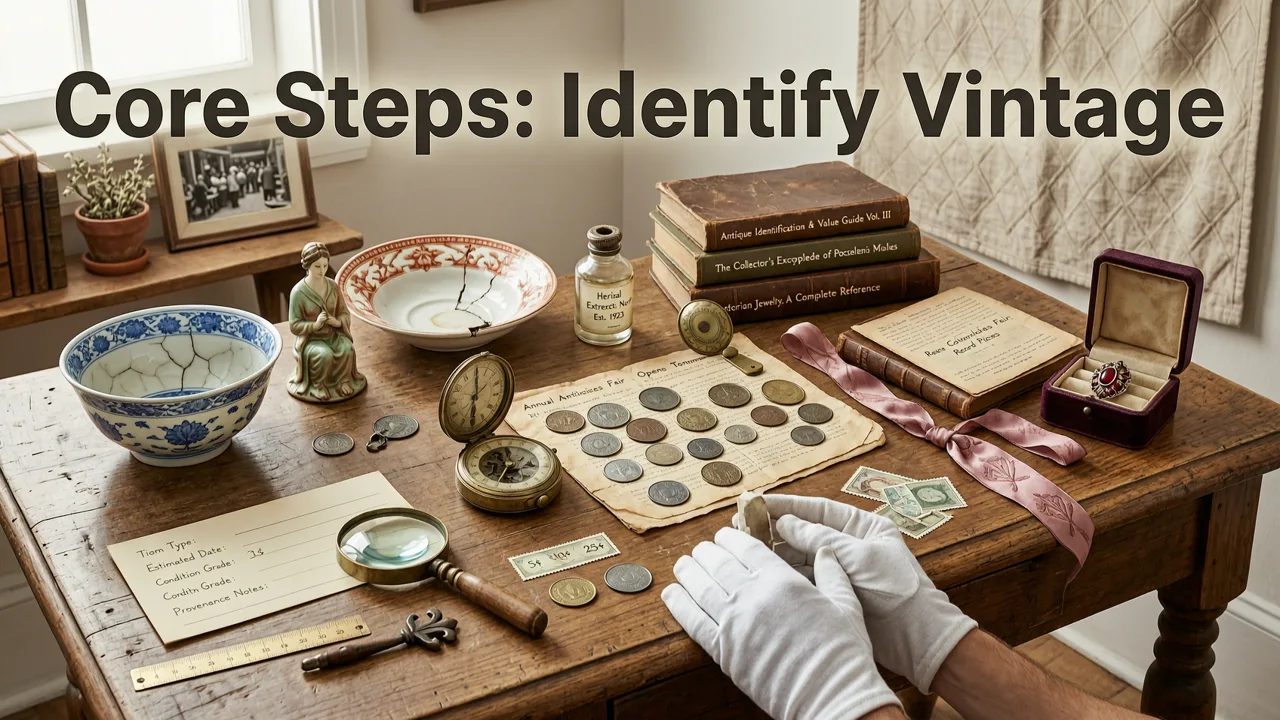
While every collectible category has its own specific nuances, the fundamental methodology for authentication remains consistent. Evaluating an object requires shifting your focus from its overall aesthetic to its microscopic and structural details.
Examining Materials, Marks, and Construction
The first step in authentication is analyzing the raw materials and how they were assembled. Historical manufacturing relied on specific joinery, casting methods, and material compositions that differ vastly from modern mass production. For wooden pieces, understanding the substrate is crucial; our guide on how to identify antique furniture wood details how to read grain patterns, pore structures, and saw marks to determine age.
Maker's marks, stamps, and labels are equally vital. These identifiers are often hidden on the underside, back, or interior of a piece. A magnifying glass is necessary to read faint impressions on ceramics or the hallmarks on silver flatware. Cross-referencing these marks with historical databases allows you to pinpoint the exact manufacturer, pattern name, and production decade.
Analyzing Patina, Wear, and Aging Signs
True age manifests in specific, often asymmetrical wear patterns. Patina is the natural oxidation and surface change that occurs over decades of handling and environmental exposure. On metals, this appears as a uniform darkening or specific color shifts in the crevices. On wood and leather, it presents as a soft, polished sheen in high-contact areas.
Recognizing authentic wear is essential, which is why evaluating the 7 signs of real antique furniture helps train your eye for genuine historical imperfections. Artificial aging, often called "distressing," tends to look uniform, overly deliberate, or confined to visible surfaces while ignoring hidden areas like drawer interiors or the underside of bases.
Category-Specific Identification Markers
Different materials and object types require specialized knowledge to authenticate. The following table breaks down the primary focus areas for some of the most commonly collected vintage categories.
| Category | Key Visual Markers | Common Forgeries | Authentication Focus |
|---|---|---|---|
| Ceramics & Porcelain | Glaze crazing, transferware alignment, kiln marks | Acid-etched crazing, modern digital transfers | Examine the foot ring, check for glaze pooling, and verify backstamps. |
| Silver & Flatware | Hallmarks, patent dates, weighted bases | Electroplated base metals stamped with fake marks | Test for magnetism, verify hallmark sequences, and inspect solder joints. |
| Vintage Glassware | Pontil marks, mold seams, bubble distribution | Machine-pressed glass mimicking hand-blown traits | Look for irregular bubbles, check the thickness of the rim, and identify UV reactive elements. |
| Textiles & Clothing | Zipper types, stitching patterns, fabric tags | Modern fabrics cut with vintage patterns | Inspect the metal of zippers, analyze the thread composition, and read union labels. |
Leveraging Technology to Identify Vintage Items in 2026
The integration of artificial intelligence into the authentication process has revolutionized how collectors and appraisers evaluate objects. Modern multimodal AI models process visual data by analyzing thousands of data points simultaneously, from the curvature of a vase to the specific typography of a maker's mark.
Modern vision models, as detailed in the OpenAI documentation, utilize advanced pattern recognition to match physical attributes against vast historical databases. This allows for the rapid identification of obscure patterns and the detection of subtle anomalies that indicate a reproduction.
As these tools become more prevalent, ethical and accurate data processing is paramount. Platforms adhere to strict guidelines, such as those outlined in the Google AI responsibility framework, ensuring that visual data is processed securely, objectively, and without bias.
For immediate, on-the-go analysis, utilizing the best app to identify antique furniture provides instant, AI-driven insights directly from your smartphone. By simply capturing an image, the software cross-references the visual data to suggest potential origins, eras, and stylistic lineages, bridging the gap between initial discovery and deep historical research.
Common Pitfalls to Avoid When Authenticating Vintage Pieces
Even experienced collectors can fall into common traps when evaluating new acquisitions. Avoiding these mistakes ensures a more accurate and reliable authentication process.
- Over-relying on a single mark: Maker's marks can be copied, transferred, or faked. Always corroborate a stamp with physical construction details and material analysis.
- Assuming age equals value: An item may be genuinely vintage but lack historical significance, rarity, or current market demand. Condition and desirability are just as critical as age.
- Ignoring proportional inconsistencies: Reproductions often fail to capture the exact proportions, weight distribution, or ergonomic curves of the original historical designs.
- Misinterpreting repairs as damage: Professional historical repairs, such as kintsugi in ceramics or traditional wood splicing, can add to the provenance of a piece rather than detract from it, provided they are properly disclosed.
Building a Systematic Approach to Authentication
Mastering the identification of vintage items is a continuous learning process that combines historical research with tactile observation. By systematically examining materials, verifying construction techniques, and analyzing natural wear patterns, you can confidently navigate estate sales, auctions, and thrift shops.
When physical inspection leaves room for doubt, modern technology offers a powerful second opinion. Combining your trained eye with advanced visual recognition ensures that your collection is built on a foundation of verified history and authentic craftsmanship.
Ready to decode your latest estate sale find? Download the Antique Identifier app today to instantly analyze, identify, and learn the history behind your vintage treasures.
Frequently Asked Questions
What is the first step to identifying a vintage item?
The first step is to examine the physical construction, materials, and any hidden maker's marks or stamps. Look underneath, inside, and on the back of the piece for manufacturer labels, hallmarks, or construction details like joinery and mold seams.
How can I tell if a vintage item's wear is authentic?
Authentic wear, or patina, is usually asymmetrical and concentrated in high-contact areas, such as the edges of a table or the handles of a drawer. Artificial distressing often looks uniform, overly deliberate, or is applied only to visible surfaces while ignoring hidden areas.
Can AI apps accurately identify vintage items?
Yes, modern AI-powered identification apps use advanced multimodal vision models to analyze physical attributes, patterns, and marks. By comparing your photos against extensive historical databases, these tools can quickly suggest the era, manufacturer, and style of the item.
Does a maker's mark guarantee an item is authentic?
No, a maker's mark alone does not guarantee authenticity. While it is a crucial clue, marks can be copied, forged, or incorrectly applied to reproductions. It is essential to cross-reference the mark with the item's materials, construction methods, and overall wear patterns.
Related Articles


Have a piece of your own to check? Photograph it with the Antique Identifier app. It's free to download for iPhone and iPad.